By BarathVector Editorial — 2026-08-13
Every artificial-intelligence announcement has an unseen cable attached to it.
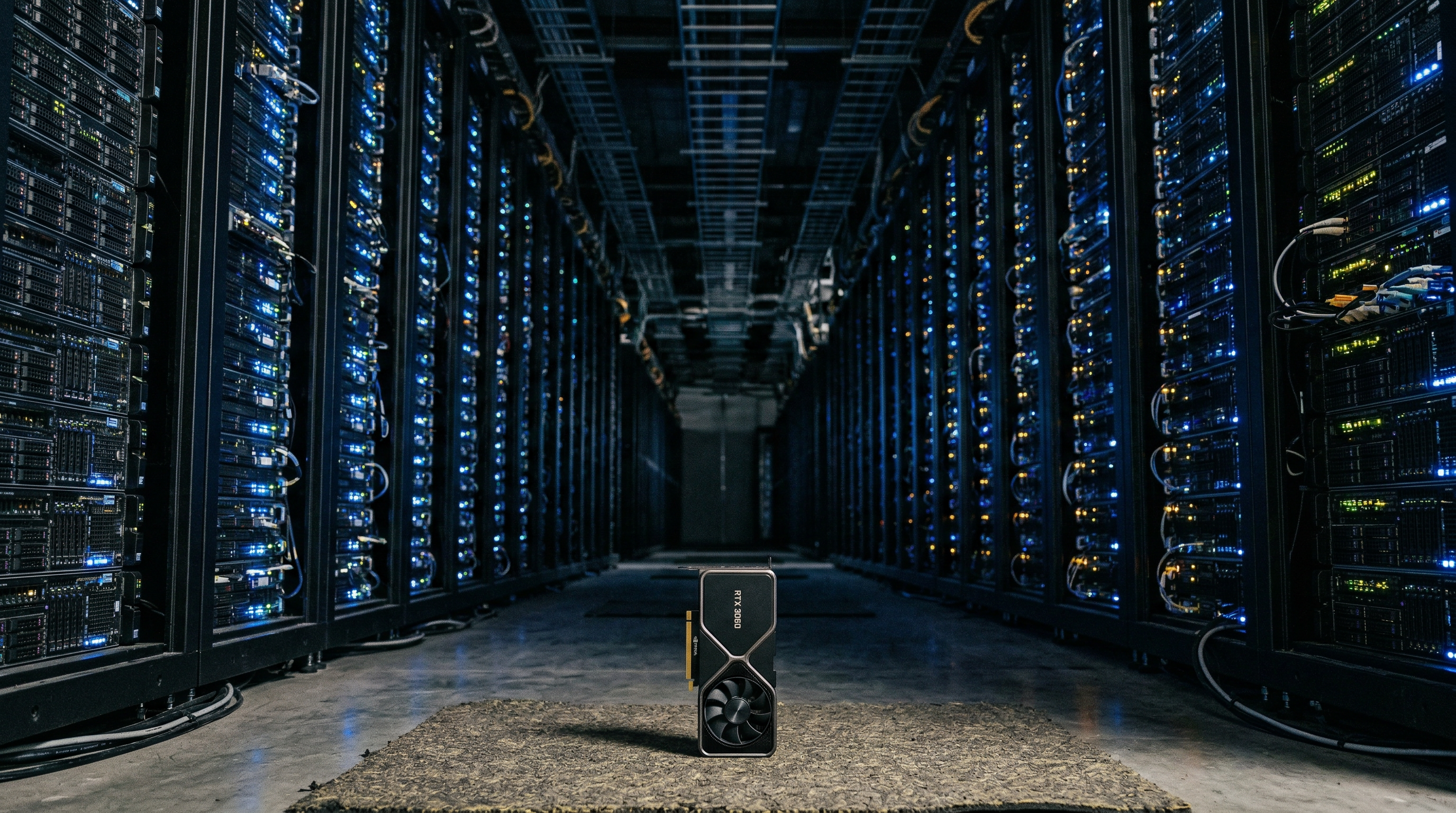
A foundation model is trained in a building. An agent runs on processors drawing electricity every second it works. Those processors create heat that must be removed. The facility needs transformers, transmission, backup, land and, depending on its cooling system, water. "Cloud" is a useful commercial term for hardware that is stubbornly attached to the ground.
India's AI debate remains dominated by the visible layer: model sizes, GPU counts, startup funding and global rankings. The less glamorous layer will decide how much of that ambition becomes usable capacity. AI policy is now electricity policy.
The Indian demand is no longer theoretical
India's data-centre capacity rose from about 375 megawatts in 2020 to about 1.5 gigawatts in 2025, according to a March 2026 government response in Parliament. The same response said electricity demand from data centres is estimated to reach 13.56 GW by 2031–32.
That does not mean every new watt will serve AI. Data centres also carry banking, commerce, government services, streaming and ordinary cloud workloads. It does mean AI is joining an already fast-growing class of concentrated, round-the-clock demand.
The global direction is unmistakable. The International Energy Agency's 2026 update says data-centre electricity consumption grew 17 percent in 2025, while consumption at AI-focused facilities rose 50 percent. The IEA expects data-centre demand to double by 2030 and AI-focused demand to triple.
Efficiency is improving at extraordinary speed. The energy required for a simple AI task has fallen by at least an order of magnitude each year in recent years, the IEA estimates. But use is growing, and the industry is moving from short text replies toward reasoning, video and agents that perform long sequences of work. Those tasks can consume hundreds or thousands of times more electricity than a simple text query.
Cheaper intelligence invites more intelligence. Efficiency reduces the cost of each unit and expands the number of units demanded.
National surplus can hide a local queue
India is not sleepwalking into this requirement. The power system met a record peak of 242.49 GW in 2025–26, while national energy shortages fell to 0.03 percent, according to the government's AI and energy summary. It points to expanding transmission, pumped storage, battery capacity, renewable generation and a future role for small nuclear reactors.
Those are substantial strengths. They are also national aggregates. A data centre does not connect to an aggregate.
It connects to a specific substation in Mumbai, Hyderabad, Noida, Jamnagar or another cluster. It needs a large block of reliable capacity at that location, not theoretical generation hundreds of kilometres away behind a congested corridor. It needs transformers whose global supply is tight, a connection delivered on schedule and backup arrangements that do not turn every outage into diesel smoke.
The IEA estimates that grid bottlenecks could delay about 20 percent of planned data-centre projects globally if they are not addressed. The risk is geographical concentration: a facility can draw as much electricity as a power-intensive factory, while far more of its demand is packed into a small number of sites.
This is why "India has enough electricity" and "this city cannot connect another campus on time" can both be true.
Water is not a footnote
Cooling makes the same problem local. Direct-to-chip liquid cooling, immersion systems and better facility design can sharply reduce water use. India's data-centre industry is adopting those methods, the government says. Yet water requirements vary by technology, climate and the electricity source serving the facility.
A campus in a water-stressed district cannot answer public concern by citing an efficient global fleet average. Nor should every facility be treated as a water guzzler regardless of its design. The useful figures are site-level: water consumed, water source, seasonal stress, recycling rate and the heat rejected into the surrounding environment.
India already fights bitter allocation disputes over farms, cities, industry and ecosystems. AI infrastructure should not enter that ledger under an exemption marked "digital."
The strongest countercase
Data centres are not about to consume the Indian grid. Even globally, they accounted for about 1.5 percent of electricity use in 2024. In emerging and developing economies, the IEA expects them to contribute about 5 percent of electricity-demand growth to 2030—important, but less than motors, cooling or electric vehicles.
AI can also help the grid. Better forecasting, predictive maintenance, demand response and faster discovery of materials can save energy. India's broader electricity expansion is necessary with or without AI.
Both points are correct. Neither removes the need to plan concentrated new loads honestly. The national question is not whether AI deserves electricity. It is whether AI investors add capacity and flexibility or merely outbid existing users for what is already there.
Additional power for additional demand
India should apply an additionality rule to major AI campuses. A project seeking hundreds of megawatts should arrive with a credible plan for additional firm supply, storage and grid upgrades—not a paper claim on renewable electricity that already serves somebody else.
The rule need not prescribe one technology. Solar and wind can supply low-cost energy; storage and transmission can shift it; nuclear, hydro and other firm sources can carry continuous demand; some computing workloads can move to hours when power is abundant. The mix should reflect the region. The obligation is to make the incremental demand visible and finance its consequences.
Power authorities should publish regional data-centre connection queues, upgrade costs and expected delivery dates. Facilities should disclose power- and water-use effectiveness in a comparable form. Public subsidies should reward reuse of heat, low-water cooling and workloads that can respond to grid conditions. Ordinary consumers should not quietly finance private substations through higher tariffs while the beneficiary calls the result foreign investment.
India's target has at times been framed as 10 GW of data-centre capacity by 2030. The government has also cited a rise from 1.5 GW to about 6.5 GW by then. Forecasts differ because projects, definitions and market conditions change. That uncertainty is another reason to build planning rules rather than celebrate a single target.
The countries that lead in AI will not merely obtain the best model. They will connect it, cool it and run it at a price their economies can sustain. Chips may be designed in California or Bengaluru. Models may be trained in English, Hindi or Tamil. The final instruction is always translated into the same physical language: watts, volts, heat and time.
There is no artificial intelligence without real electricity. India's power planners are already writing part of its AI future. The country should begin reading the document.