By Ramachandran Rajeev Kumar — 2026-07-15
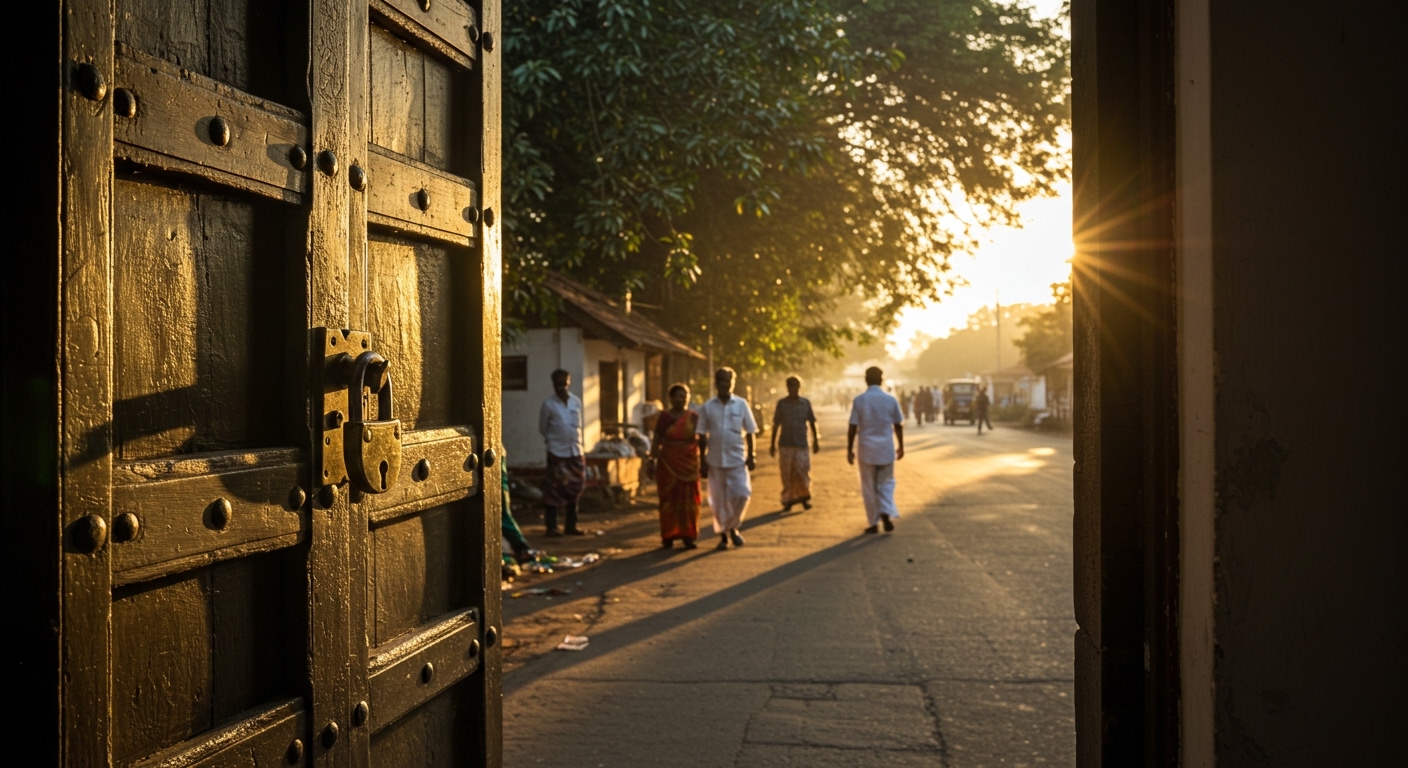
On 12 July 2026, at Achipatti near Pollachi in Coimbatore district, K. Annamalai stood before the first major rally of his We The Leaders foundation — a conference themed, deliberately, on a drug-free Tamil Nadu — and said something no leader of a Dravidian party has said in sixty years and meant: "I am a Hindu, but when I step out, I lock up my caste and religion inside my house."
He went further. A true Hindu, in his telling, treats everyone equally and refuses to rank one person above another; there is no need, he said, to highlight and display religion at every turn — that, he called his Hindu philosophy. He described himself as Indian first, with caste and faith as private matters that stay at home. And he drew the line for his movement in a single sentence: "Religion is outside the scope of this organisation. Our politics is focused on making Tamil Nadu a leading state. Responsibility is our identity."
Tamil Nadu should take that sentence seriously, because it arrives at the exact moment the state's politics has become capable of rewarding it.
The Binary That Ran Out of Ideas
For fifty-nine years, power in Tamil Nadu alternated between two parties born of the same movement. The Dravidian project began as something genuinely radical — Periyar's rationalism, the assault on caste hierarchy, the promise of self-respect. But movements that win everything eventually administer everything, and what the DMK and AIADMK administered, decade after decade, was a politics that ran on the very fuel it once set out to burn: caste arithmetic in candidate selection, competitive identity appeals at election time, and succession managed like a family estate. The policy distance between the two parties narrowed to the width of a welfare scheme's name. Voters were not choosing between visions; they were choosing between dynasties that had learned to speak the same language with different accents.
The 2026 election broke that machine. TVK's victory — 108 of 234 seats, a record 85.1 per cent turnout — was not merely a change of government. It was the first time in six decades that Tamil Nadu's voters handed the state to a party that belonged to neither branch of the Dravidian family tree.
Two Outsiders, One Standard
Here is what makes July 2026 remarkable: the man now running Tamil Nadu and the man positioning himself as its next challenger are converging on the same political grammar from opposite ends of Indian public life.
Vijay came from cinema — and yes, TVK is in form a classic Tamil movie-star party, the kind this state has manufactured before. The difference lies in what he has done with the form. He has, by all reporting so far, kept his family out of the party and the government — a quiet but pointed break from the inheritance model. He has said, in widely reported remarks, that he belongs to Hindus, Muslims and Christians alike. His first gestures in office ran to the Periyar memorial and a courtesy call on the leader of the opposition, and after his alliance's first coordination meeting on 1 July, his message was secular, corruption-free governance — not a settling of scores. Two months is far too early to grade a government, but it is not too early to notice which standards it has chosen to be graded by.
Annamalai came from the other direction entirely: a decorated IPS officer who led the Tamil Nadu unit of the BJP — a party whose national identity is inseparable from religion — for nearly four years before resigning its primary membership in June and building a movement that claims nineteen lakh members in thirty-eight days, seventeen per cent of them women. Those are the movement's own numbers, and launch enthusiasm is not an electoral base. But watch what he chose for his first big stage. Not a temple. Not a caste conference. Not a grievance rally against the party he left — by his own account he was angry with the BJP, "but I had to show it with a sense of responsibility," and in the forty days since, he has not attacked it once. He chose drug abuse: an unglamorous, unifying governance problem, closed with six concrete resolutions on enforcement, liquor-outlet placement, and rehabilitation. First rallies are mission statements. This one said: we will compete on problems, not identities.
When the ruling party and its most ambitious challenger both stake their futures on governance rather than caste and creed, something structural has changed. Political competition is a market, and markets are defined by what the leading players compete on. For sixty years the competition in Tamil Nadu was over who could assemble the better identity coalition. The competition now taking shape for 2031 — Vijay's delivery record against Annamalai's leadership pipeline — is over who can run the state better. That is a repricing of the entire market, and every party that wants to survive in it, the DMK and AIADMK included, will have to adjust to the new terms.
The Convenience Objection, Answered
The obvious retort writes itself: it is easy to lock religion at home after leaving the party of religion, and a man who spent four years as the BJP's most visible face in Tamil Nadu does not get to reinvent himself in one speech. Fair. Scepticism about conversion narratives is healthy, and Annamalai's will be tested over years, not news cycles.
But two things deserve weight. First, the standard matters more than the messenger. If Tamil Nadu's politics extracts a public commitment from its rising leaders that caste and religion stay out of the organisation — on the record, at a founding rally, in front of the cameras — that commitment becomes a stick voters and journalists can beat them with the moment they stray. Hypocrisy only has a price when the standard has been stated. Annamalai just stated it, in words no one will let him forget.
Second, the direction of travel is the point. Indian politics has no shortage of leaders who discovered religion on the way up. It has vanishingly few who discovered its irrelevance to governance — and said so in Tamil Nadu, to a mass audience, while asking them to sign anti-drug pledges instead of identity petitions. Whatever one thinks of Annamalai's past affiliations, the incentives he is now building his movement around point away from division, and incentives are what outlast speeches.
The Laboratory State, Again
Tamil Nadu has been India's political laboratory before. The Dravidian movement's social-justice architecture — reservations, mid-day meals, public health delivery — was studied and copied across the country. If the state that perfected identity-first mass politics now demonstrates that elections can be won, and governments run, on responsibility-first terms, that demonstration will not stay within its borders. Every state trapped in its own caste arithmetic will have a working counter-example.
None of this is guaranteed. TVK must convert pledges into administration. Annamalai must convert a foundation into a party — he says the transition will come at "the appropriate time," with 2031 as the declared horizon — and a viral membership drive into cadre who knock on doors in all 234 constituencies. Either or both could fail, and the old machine is patient.
But for the first time in living memory, Tamil Nadu's political future is being contested by leaders who treat caste and religion as things to be left at the door rather than weapons to be carried into the arena. One of them said it out loud in Pollachi. The other is being measured against it in Chennai. The state, and the country watching it, are better for both.