By Ramachandran Rajeev Kumar — 2026-07-16
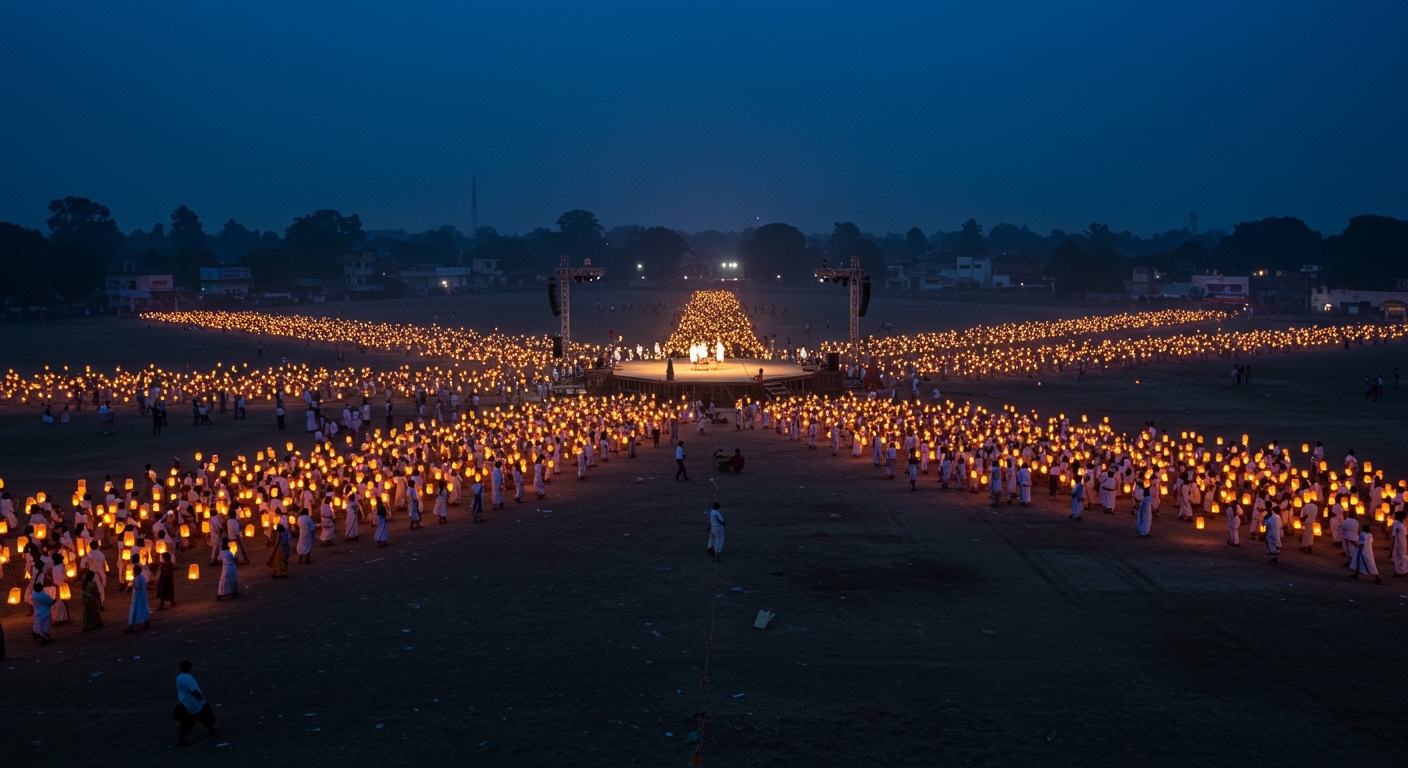
On 5 June 2026, K. Annamalai walked away from the BJP's primary membership — three days after a meeting in Delhi with national president Nitin Nabin and Amit Shah, a meeting that, in hindsight, reads like a last attempt to keep him in the fold, though neither side has said so. He didn't take a pause to reflect. He announced "We The Leaders" the same day. Within hours, more than 7.6 lakh volunteers had signed on. Within three days, membership had crossed 1.7 million.
Numbers like that don't usually follow a resignation letter. They follow a launch. These pages made the case for his standalone bet the week he walked (Annamalai Was Right to Go It Alone. Now He Gets To.); six weeks on, the question has changed. Annamalai didn't leave a party so much as he opened a second front, and Tamil Nadu's political class — across the TVK-led coalition with Congress and the Left that now runs the state, across a DMK adjusting to opposition benches for the first time in years, across an AIADMK trying to rebuild after 2026, across a BJP he just left — has to decide what to do with that front. The easy answer is to treat it as a threat to be managed. The more useful answer is to treat it as a template worth borrowing from.
A Vision Bigger Than the Man Who's Selling It
Strip away the personality and what remains of "We The Leaders" is a fairly specific governing philosophy: recruit and train people before you hand them power, run decisions on data rather than dynasty, and build institutions that outlast any one leader's popularity. The planned A. P. J. Abdul Kalam Centre for Ethics and Politics in Coimbatore is the clearest expression of this — a facility meant to produce cadre and future officeholders, not just campaign volunteers.
That is not a Tamil Nadu-specific idea, and it is not a BJP-specific idea either. It is closer to a management philosophy applied to public life: professionalize the pipeline, measure outcomes, resist the pull of the family enterprise. Tamil Nadu's two dominant parties for six decades were built substantially around individual charisma and inherited succession. TVK's own rise in the 2026 election — a film star's party winning 108 of 234 seats and ending 59 years of DMK-AIADMK dominance — shows how much appetite there still is for politics organized around a single commanding figure. Annamalai's proposition runs the other way: build the bench, not just the batsman.
This is where the case for engagement gets interesting for people who have no interest in ever voting for Annamalai's eventual party. A DMK-aligned college administrator, an AIADMK cadre leader, a Chennai business association, a Madurai civil-society group — none of them need to join a movement to benefit from what it is trying to institutionalize. Ethics training for aspiring public servants, data-driven approaches to municipal problems, structured leadership development for the young people who currently see politics as either inheritance or celebrity — these are public goods. A rival party can compete with Annamalai's electoral ambitions in 2031 while still sending its own young cadre through the kind of training his centre proposes to offer, or while adopting his data-driven habits in its own governance. Rallying behind the vision and joining the party are two different acts, and Tamil Nadu's institutions have more to gain from the first than they risk from the second.
Freed to Say What Needed Saying
Annamalai's criticism of the security apparatus around the NEET-UG re-test — the CRPF and CISF deployment, the biometrics, the layered frisking that turned an exam into something closer to an airport lockdown — is a small example of a larger point. Inside a party structure, that kind of comment risks becoming a coalition management problem. Outside one, it's just an observation an engaged citizen was free to make about student welfare. Whatever one makes of the specific critique, the freedom that produced it is the same freedom "common man politics" is built on: unbundling ethical positions from party discipline.
Tamil Nadu's civil society and education sectors, which regularly find themselves managing the fallout of decisions made for electoral rather than administrative reasons, have an obvious interest in a political actor willing to say inconvenient things without checking with a high command first. That doesn't require anyone to like him. It requires recognizing that a crowded political field with one more voice unafraid of its own coalition is healthier than one without it.
What the Skeptics Get Right
None of this should be waved through uncritically, and the skepticism deserves a straight answer rather than a dismissal.
The most serious challenge, laid out pointedly in commentary such as Countercurrents' "The Controlled Release," is that Annamalai's exit could be a sanctioned long game rather than a genuine break — a way for the BJP to keep a foothold in Tamil Nadu through a proxy while officially disclaiming him. There is no way to settle that from the outside in mid-July 2026. The test will be visible only in what "We The Leaders" does when its interests diverge from the BJP's — on alliances, on criticism, on which battles it picks. Time, not the resignation letter, will answer the question.
The second problem is timing. TVK's victory means the "fresh alternative to dynastic politics" lane, which Annamalai is explicitly trying to occupy, is no longer empty. Vijay's government has already converted outsider energy into actual power. Annamalai is not entering a vacuum; he's entering a market with an incumbent who got there first and is currently running the state.
The third is structural. Movements that convert into parties have an uneven record everywhere, and 1.7 million members three days after launch is a measure of enthusiasm, not of votes, cadre discipline, or seats. Signing up is cheap. Door-to-door organizing across 234 constituencies is not.
The fourth is the most self-referential: a movement built this heavily around one man's personal draw, launched to oppose cult politics, has to explain why it isn't itself an instance of the thing it opposes. The Kalam Centre is Annamalai's own answer — an attempt to build an institution that could, in principle, survive and outlast him. Whether training produces genuine bench strength or simply a loyal support structure around a single figure is exactly the kind of thing that can't be verified from a launch announcement. It has to be watched over years, through who actually gets promoted and how decisions get made when he isn't in the room.
What the Next Five Years Decide
Annamalai has said the movement will become a full party and contest the next Tamil Nadu assembly election. Getting there means converting a viral first three days into standing organization across a state where two entrenched parties have just been humbled by a third, and where his own former party still calculates his usefulness in terms of Delhi's interests rather than Chennai's.
The stakes reach past Tamil Nadu. If a movement built on trained leadership, ethics-first conduct, and data-driven governance can win seats without leaning on either dynasty or celebrity, it becomes a template other states can study. If it collapses into a personality vehicle indistinguishable from the ones it set out to challenge, that will be read nationally as confirmation that Indian politics simply doesn't reward that kind of bet. Either way, Tamil Nadu's other leaders don't need to wait for the verdict to start borrowing the parts of the model that already work. The training pipeline, the ethical guardrails, the discipline of measuring before deciding — those are available to anyone willing to adopt them, regardless of which party symbol they campaign under next.