By BarathVector Editorial — 2026-08-22
India's Supreme Court has delivered two answers to one of labour law's most persistent questions: what counts as an “industry”?
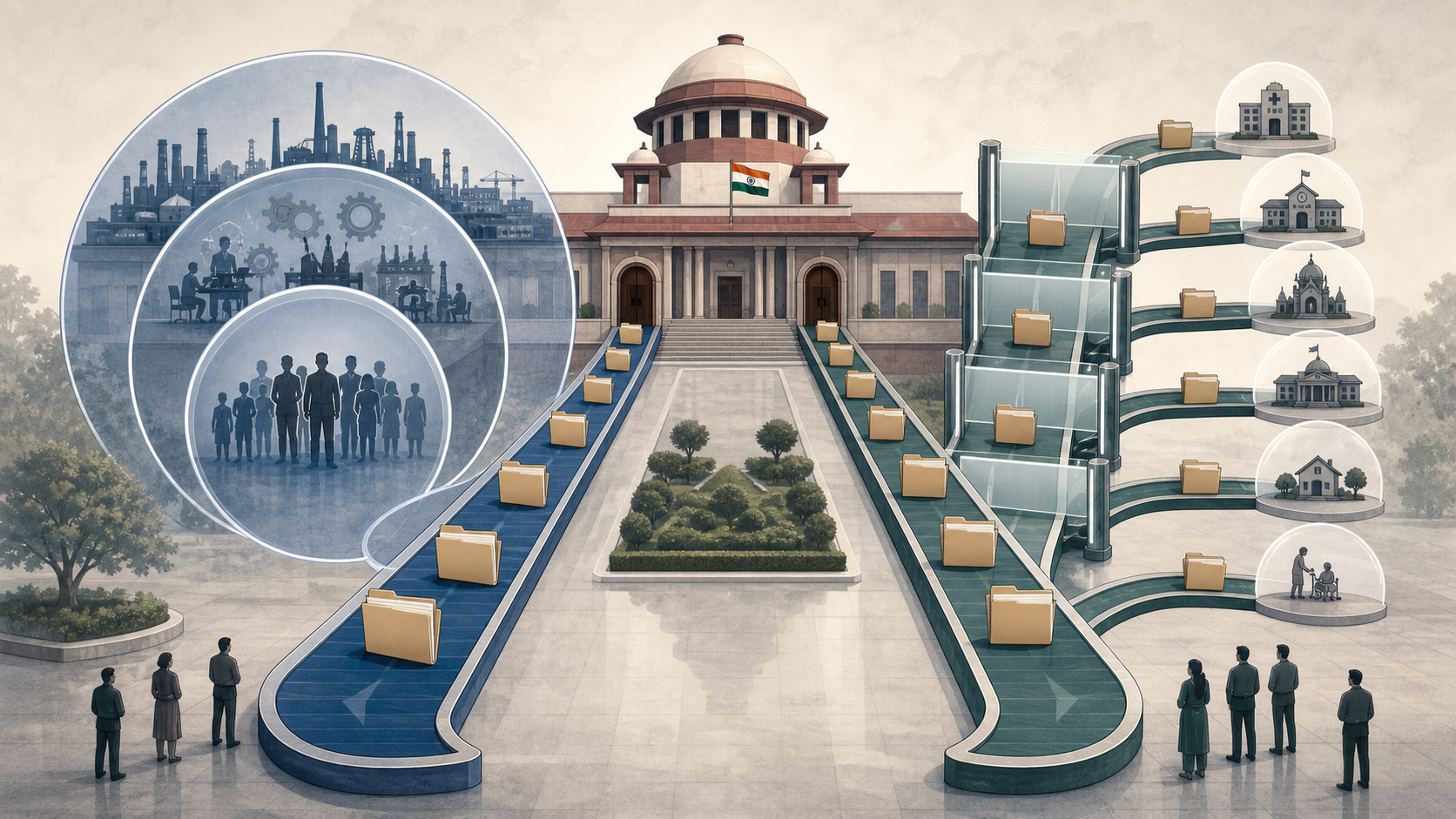
For disputes governed by the repealed Industrial Disputes Act, 1947, the broad test laid down in Bangalore Water Supply and Sewerage Board v. A. Rajappa in 1978 survives. For new disputes under the Industrial Relations Code, 2020, that precedent does not control. The new definition must be interpreted independently.
The 6-3 ruling in State of Uttar Pradesh v. Jai Bir Singh is therefore protective and disruptive at once. It prevents long-pending cases from losing their legal foundation halfway through litigation. It also refuses to use an old judgment to fill, narrow or override the choices Parliament wrote into the new Code.
Political criticism has focused on the second part. Congress said distancing the new Code from the old worker-friendly precedent risks weakening safeguards. Trade unions have voiced similar concern. The risk is real, but its author must be identified accurately. The Code's express exclusions were enacted by Parliament. The court has not yet decided their full reach.
The next democratic task is not to pretend the judgment itself removed millions of workers from protection. No public evidence presently supports that number. It is to determine, institution by institution and worker by worker, who falls outside the new definition—and whether Parliament intended every resulting exclusion.
Why one word controlled so much
The 1947 Act applied its dispute-resolution machinery to a “workman” employed in an “industry.” Section 2(j) defined industry through a short list: business, trade, undertaking, manufacture or calling of employers, along with the corresponding service, employment or occupation of workmen.
In 1978, a seven-judge bench converted that sparse text into a functional test. An activity was prima facie an industry when it was systematic and organised, involved cooperation between employer and employee, and produced or distributed goods or services to satisfy human wants. Profit motive and private ownership were not required. The original formulation reproduced in the Supreme Court record became known as the triple test.
That reading could bring hospitals, educational institutions, research bodies, clubs, charitable organisations, municipal services and welfare departments within industrial law, depending on the nature and organisation of their activity. Strict sovereign functions remained outside. Where an institution mixed industrial and non-industrial work, courts examined its predominant character and whether units could be separated.
The breadth protected workers from being denied a labour remedy merely because their employer was public, charitable or non-profit. It also produced decades of borderline litigation. Is a social-forestry department delivering a service or performing government? Is teaching the service, or is the institution's relationship with non-teaching staff the relevant cooperation? Lower benches reached conflicting results.
The Jai Bir Singh litigation arose from that confusion. A five-judge bench questioned Bangalore Water Supply in 2005. A nine-judge bench was finally constituted in 2026 after the Supreme Court identified four questions, including welfare activities, sovereign functions and the effect of later legislation.
What the court preserved
The majority concluded that the broad 1978 interpretation was valid for the old Act. The triple test had support from five members of the seven-judge bench and had governed industrial relations for nearly half a century. Difficulty at the margins did not justify stripping it of authority.
Separate opinions took different routes, but six judges agreed on the operative protection for legacy disputes. LiveLaw's report on the holding states that Bangalore Water Supply will govern pending cases under the 1947 Act. PTI reported that these include disputes involving hospitals, educational institutions and government departments.
Justice P.S. Narasimha offered the clearest access-to-justice reason. If the court narrowed the old test only for the remaining cases, workers who had litigated for years could be pushed out of labour adjudication and told to begin again in civil court. The published judgment text records his conclusion that the old ratio should finish the work it began.
That is not judicial sentimentality. It is legal continuity. People arrange claims, evidence and strategy around the law in force. Changing the jurisdictional test near the end would reward delay and punish reliance.
What Parliament changed
The Industrial Relations Code came into force on 21 November 2025 under notification S.O. 5320(E). It replaced the short definition with a more detailed one.
Section 2(p) retains the skeleton of the triple test: systematic activity, employer-worker cooperation and the production, supply or distribution of goods or services. Capital investment and profit motive remain irrelevant. But the Code expressly excludes institutions owned or managed by organisations wholly or substantially engaged in charitable, social or philanthropic service; government activity related to sovereign functions, including central departments dealing with defence research, atomic energy and space; domestic service; and any other activity the Centre may notify.
Those exclusions are visible in the official Code text. They do not automatically remove every hospital, school or research institute. A private commercial hospital is not a charitable institution merely because it provides health care. A non-profit's label does not settle whether it is “wholly or substantially” engaged in the excluded service. Courts will have to interpret the text and the facts.
The court was right not to import the old test as a controlling gloss. A new statute with new wording ordinarily receives its own interpretation. Otherwise judges would convert legislative revision into decorative editing.
The strongest counterargument is that statutory independence can become a route to avoid a protective precedent. Parliament reused much of the functional definition; why should decades of labour jurisprudence become irrelevant? The answer is that old cases may remain persuasive where text and purpose align, but they cannot erase an express exclusion. The legitimate fight is over what those exclusions mean and whether they are justified.
The coverage audit India now needs
The Labour Ministry should publish interpretive guidance before years of new litigation recreate the old uncertainty. The guidance should include examples for hospitals, schools, universities, research bodies, religious charities, government societies, public-service contractors and mixed-purpose institutions. It cannot bind courts, but it can tell workers and employers how the government understands its own law.
More importantly, the Centre should produce a coverage assessment. How many establishments previously treated as industries may invoke each exclusion? How many workers do they employ? Which industrial-relations remedies would cease to apply, and what alternative forum would remain? The 2019 parliamentary committee recorded stakeholder objections to excluding charitable and philanthropic institutions in its report on the Code. That debate now needs evidence rather than competing estimates.
Employers also need clarity. A hospital or university should not spend a decade litigating jurisdiction before the merits of a dismissal are heard. Certainty lowers compliance costs; it does not require the narrowest possible worker coverage.
The government should publish tribunal decisions by exclusion invoked, sector, worker category and outcome. After two years, Parliament should review the data. If large groups have lost industrial remedies without a workable substitute, the definition should be amended. If feared exclusions do not materialise, the evidence will show that too.
The Supreme Court has settled the old law without pre-deciding the new. That is a defensible judicial boundary. It leaves the central policy choice where it belongs: with the Parliament that wrote the exclusions and the government responsible for explaining their consequences.
This article does not offer legal advice. Coverage under the Industrial Relations Code depends on the institution, activity, worker status and facts of the dispute.