By Ramachandran Rajeev Kumar — 2026-07-09
Two days ago in these pages we wrote that treaties signed at Versailles have a way of incubating the next war, and that this one was no exception. We take no satisfaction in how quickly the point proved itself. The memorandum of understanding between Washington and Tehran — negotiated in Islamabad, signed three weeks ago at the Palace of Versailles — is now ash in fact, not merely in metaphor. On Wednesday, standing at the NATO summit in Ankara, President Trump said the words himself: the ceasefire is over.
The manner of its death matters, because the sequence tells you everything about what comes next.
How three weeks of peace burned
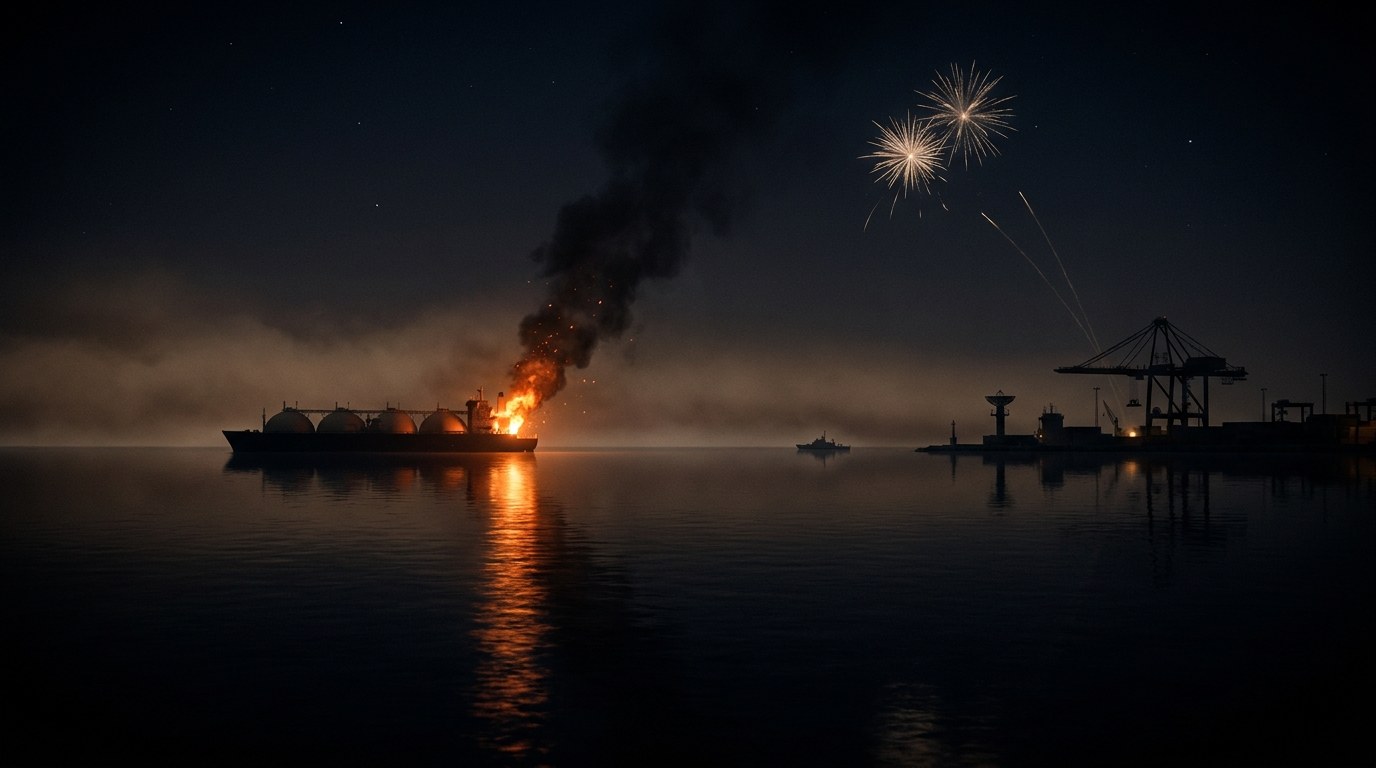
On Monday night, Iran's Revolutionary Guard fired missiles at commercial ships transiting the Strait of Hormuz — the same strait the Versailles memorandum obliged Tehran to open. A Qatari gas carrier, the Al Rekayyat, took a projectile in its engine room and burned; a Saudi-flagged crude tanker was damaged; a third vessel was struck by a drone off Oman. The crews survived. The memorandum did not. Within hours, the US Treasury revoked the sanctions waiver that had let Iran sell its oil freely — the sweetener that made Versailles signable. Hours after that, in the early dark of Wednesday, American forces struck what Central Command described as approximately ninety military targets along Iran's southern coast: air defences, coastal radars, missile and drone storage, naval assets and docks from Bandar Abbas to Jask. Iranian reports put the toll of two days of strikes at fourteen dead and seventy-eight wounded.
And then Iran did the thing it always does, the thing we described in the first piece as the whole grammar of its deterrence: it hit the hosts, not the principal. Ballistic missiles and swarms of one-way drones went at American bases in Kuwait and Bahrain, at an early-warning site in Qatar, at a base in northern Jordan. The Revolutionary Guard claimed strikes on dozens of American military sites across Bahrain and Kuwait; the defence ministries of the countries actually underneath the interceptions reported the arithmetic more soberly — Kuwait counted three ballistic missiles, a cruise missile and ten drones shot down, damage on the ground from the debris, one person injured. Jordan intercepted at least eight missiles that crossed into its airspace. Parliament Speaker Ghalibaf supplied the caption: if you strike, you will get hit.
The dance of uncertainty has resumed, and both partners have kept their old steps.
Tehran's step — and a Gulf that is changing under it
Tehran's step is unchanged: blackmail dressed as deterrence, aimed at the neighbours rather than the adversary, on the theory that Gulf fear is the cheapest lever available. But something in the Gulf has shifted since we last wrote, and it deserves notice. In the spring, the monarchies absorbed Iranian pressure in near silence and leaned on Washington to make it stop. This week they found their voices. Kuwait called its sovereignty a red line. Bahrain's defence force accused Tehran of a systematic aggressive approach and said it stands ready to answer further attacks. The Emirati diplomatic adviser Anwar Gargash said plainly that Iran has shown itself incapable of committing to the requirements of de-escalation. These are not the words of governments waiting to be rescued; they are the words of governments beginning to conclude that the rescuer is unreliable and the aggressor is unappeasable, and that they may have to arrange their own security accordingly. Fear, held long enough, curdles into something harder. Tehran's planners should read those statements twice: the blackmail thesis works only while the victims believe accommodation is cheaper than resistance.
Washington's step — a menu, not an objective
Washington's step is also unchanged, and that is the graver problem. Mr Trump's declaration in Ankara was not a strategy; it was a mood. He is angry — angry that the strait is not open, angry that ships burned while he sat at a summit — and the anger has produced a menu rather than an objective: probably more strikes, maybe a reimposed naval blockade, maybe strikes on power and water plants, maybe, in his own words, taking over Kharg Island. Every item on that menu is an escalation; none of them is an end-state. We said in the first piece that only two coherent choices exist — leave entirely, with all the humiliation that carries, or commit to breaking the hardline regime's capacity to wage this kind of war. Ninety targets on a coastline is neither. It is the half-war continuing, the same half-war that has already run five months, and half-wars do not conclude; they metastasise.
The people paying for the metastasis are the usual ones. Along Iran's southern coast, the fishermen of Bandar Abbas and Jask — men whose boats and jetties sat next to the Revolutionary Guard's speedboat docks because the Guard builds its war beside other people's livelihoods — have lost both, and Iranian residents describing the ruin to journalists were not mourning the regime; they were mourning their nets. The peaceful majority of the Islamic world, in whose name we insisted the first piece was written, is once again the population underneath the trajectories: Kuwaiti families under interception debris, Qatari gas crews in burning engine rooms, Jordanian towns watching missiles cross their sky in the dark. None of them voted for this war. All of them are billed for it.
The bill arrives by sea
For India, the bill arrives by sea. The Al Rekayyat was carrying liquefied natural gas of the kind that heats Indian kitchens and fires Indian plants; a strait that closes, or merely becomes uninsurable, taxes every household from Kochi to Kanpur within a fortnight. Delhi's interest has not changed since Tuesday: a Gulf where commerce moves and neither a triumphant hardline Tehran nor an open-ended American war defines the region's weather. The mediators now shuttling between the parties, urging both back to the memorandum's terms, deserve India's loud support — not because the memorandum was good, but because the alternative on display this week is worse.
Where does it go? Watch three things. Watch whether Washington names an objective — any objective — because a war with a stated end can end, and a war without one cannot. Watch whether the Gulf's new candour hardens into policy: air-defence integration, procurement, the quiet conversations with Israel that Tehran's behaviour keeps making thinkable. And watch Kharg Island, because if that threat becomes an operation, the half-war is over and the full one has begun.
Versailles kept its promise. The question that remains is the one from our first piece, unanswered still: a U-turn is not a sin if it finally leads somewhere. Two days of fire later, nobody in Washington or Tehran can say where.
Sources: strike counts and target characterisation per US Central Command statements; ship-attack details per British military reporting via the Washington Post and Bloomberg; interception figures per the Kuwaiti Ministry of Defense and the Jordanian Armed Forces; Iranian casualty figures as reported by Iranian officials via Al Jazeera and IranWire; Gulf-state statements per Arab News, The National, and Gulf News; ceasefire and sanctions record per Al Jazeera, NPR, Forbes, and CNN. Facts current as of 10 July 2026.