By BarathVector Editorial — 2026-07-30
Let the concessions come first, in full, because this editorial does not need to dodge a single fact to make its case.
The NEET-UG 2026 paper leaked. That is not an allegation; the Education Minister admitted it on May 15, conceding that "under the guise of a guess paper, the actual examination questions had indeed been leaked." The exam was cancelled, the CBI called in, a re-exam held under the same agency that lost the paper the first time. The government failed the students — and Dharmendra Pradhan's resignation on July 25 was not a scalp unjustly taken. It was accountability fairly owed. When lakhs of families mortgage a decade of childhood to a single question paper, the minister on whose watch that paper walked out of the vault does not get to stay.
And the government's failure runs deeper than one leak. The machine itself is the scandal. India still sorts its young through what is, in architecture and spirit, the British clerical examination — a nineteenth-century instrument built to select obedient clerks for an empire, now scaled to industrial size and asked to identify the talent of a spacefaring nation. Memorise, regurgitate, rank, discard. No government — this one included — has found the courage to replace that architecture rather than administer it. The leak was a crime; the system it leaked from is a fossil. Both truths belong on the government's account.
Concede all of that. Every word. And then ask the question this news cycle has refused to ask: who gave the Cockroach Janta Party the right to collect on this grievance?
The Founding Résumé
The movement's founding myth is spontaneity — a wounded generation rising overnight because a Chief Justice compared jobless youngsters to cockroaches. Its founding résumé says otherwise. Abhijeet Dipke is not a wronged aspirant who walked out of an exam hall; he is a 30-year-old professional campaign operative with a master's in public relations from Boston University, who spent 2020 to 2023 running social-media strategy for the Aam Aadmi Party. The mascot, the flags, the acronym engineered to mirror the ruling party's — this is not the artless fury of the young. It is the product design of a man trained to manufacture exactly this, in the school of Indian politics that has industrialised the technique: AAP, the party that perfected agitation as product and governance as afterthought. It is no accident that the first national leader to arrive at Jantar Mantar in solidarity was Arvind Kejriwal, embracing a movement built by his own former staffer.
None of this requires a foreign hand — and honesty requires noting that the Ministry of External Affairs itself dismissed the foreign-funding allegations against the movement. The truth is less exotic and more damning: the incentives are entirely homegrown. In the AAP school, a grievance is never a problem to be solved. It is an asset to be harvested — kept raw, kept trending, kept unresolved, because resolution ends the franchise.
The Conduct
Watch how the franchise operated. Its opening move at Jantar Mantar on June 6 was not a reform proposal but a seven-day ultimatum for a minister's head. When the Delhi High Court directed that Sonam Wangchuk, twenty days into a hunger strike, be moved to hospital, the movement's official word for a court-directed medical admission was "abduction." Its demand sheet priced the grief of suicide-bereaved families at one crore rupees apiece — mourning converted into a negotiating line-item. Its manifesto demands that a Chief Election Commissioner who cancels a legitimate vote be charged under UAPA, vote deletion being, in its words, "an act of terror" — satire, its defenders insist, though one struggles to laugh at a youth movement whose comic imagination runs to terror charges against constitutional officers.
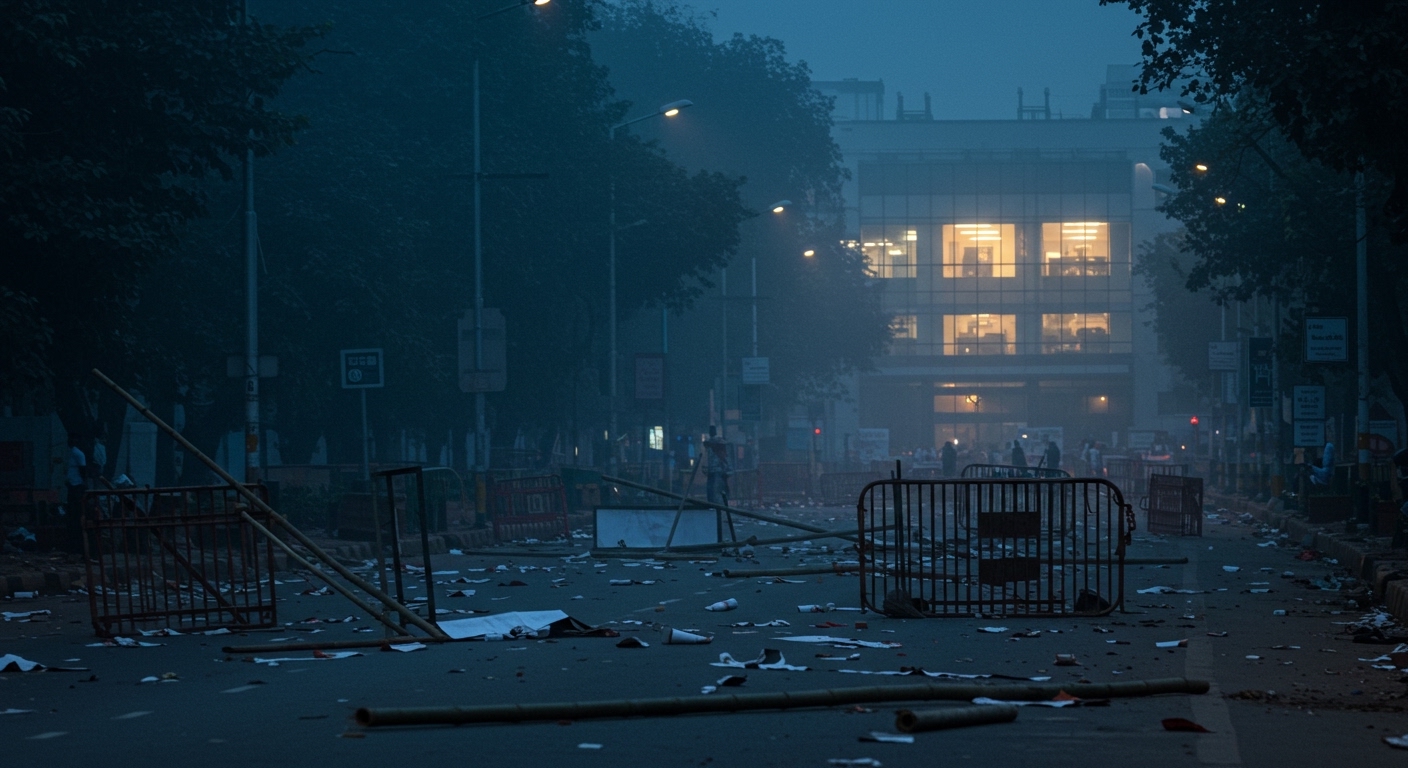
Then the stones. Fairness requires precision here: what happened on July 20 is contested — police casualty claims, hospital counts, and the movement's own figures all diverge; reporters on the ground saw police initiate with tear gas and batons; and Delhi Police's flat denial of pellet-gun use collapsed against the government's own paperwork, a hospital report recording pellets removed from a teenager's eye and a station diary recording the rounds fired. The police conduct that week disgraced the uniform, and this newspaper says so plainly. But July 22 and July 25 are not contested: stone-pelting from the protest's ranks injured two Assistant Commissioners of Police and four personnel one evening, and a Special Commissioner and two officers three days later. A movement that cannot keep stones out of its own crowd's hands has forfeited the word "peaceful" — and a movement that ends its siege at a joint press conference with Union ministers, trophy in hand, has revealed what the siege was for.
The Fraud of the Face
Here is the claim that must not survive this episode: that this operation is "the face of GenZ India." Tens of millions of Instagram followers are not a generation. They are an audience — and an audience is precisely what a PR professional builds.
India's actual GenZ was somewhere else that afternoon. It was in the laboratories taping out indigenous silicon, in the startup floors that have built the world's largest real-time payments system, in the mission rooms that soft-landed a spacecraft on the lunar south pole for less than the cost of a film franchise, on the stages and in the stadiums where young Indians now perform to the world, in the training halls of the industries that stalwarts built from nothing and that their successors are scaling. That is the face of this generation: builders, not free-baiters. The cockroach movement flatters the opposite instincts — grievance as identity, spectacle as achievement, entitlement as ideology — and calls the flattery empowerment. A generation this capable deserves role models who made something, not mascots who monetised the making of noise.
The Vacuum That Bred It
Why did a meme with a PR budget get to play national opposition for nine weeks? Because the actual national opposition has vacated the premises. The Congress party's contribution to this episode was to declare the movement "not a political party," hedge for six weeks, and then have its two most senior leaders photogenically detained marching on the Prime Minister's residence — leadership by press release, opposition by photo opportunity. A party that has spent a decade as a family firm with a famous surname cannot anchor the nation's discontent, and so the discontent went looking for anchors in the gutter of virality. India urgently needs an opposition with a national conscience — one that treats the country as a cause to be served rather than an inventory to be liquidated for the next news cycle. It has, instead, an embarrassment in dynastic receivership; and nature, abhorring the vacuum, sent a cockroach.
What the Anger Deserved
The anger of July was real, and it deserved better owners. It deserved a movement that demanded the dismantling of the clerical examination raj and the building of an assessment system worthy of the students it sorts. It deserved leadership drawn from the generation's builders, not its brokers. It deserved an opposition capable of converting a minister's fair resignation into structural reform, rather than a franchise that banked the trophy and called off the show.
Instead, the students got a press conference, the operative got a platform, AAP's school of politics got its newest campus — and the examination system that started it all stands exactly as Macaulay's heirs designed it, waiting to leak again. The anger was stolen. The generation it was stolen from should ask for it back — and invest it where they always meant to: in their own growth, and through it, the nation's.