By Ramachandran Rajeev Kumar — 2026-07-06
Bharath Manthan - Episode 18
By Ramachandran Rajeev Kumar
The Arithmetic of Union: What Comes After the Freeze
When one person, one vote meets a union of states
On the evening of April 17, 2026, the Lok Sabha did something it almost never does. It said no.
The Constitution (131st Amendment) Bill — the most consequential redesign of Parliament attempted in fifty years — received 298 votes in favour and 230 against. A comfortable majority in any ordinary legislation. But constitutional amendments demand a two-thirds majority of members present and voting, and the arithmetic was unforgiving: 352 votes were required. The government fell 54 short. The companion Delimitation Bill and the Union Territories Bill were withdrawn the same week.
The half of India that had dreaded this bill exhaled. The exhale was premature.
What died on April 17 was a bill. What did not die — what cannot die, because it is written into the Constitution itself — is the deadline. The freeze on parliamentary seats, in place since 1976, expires with the first census taken after 2026. That census has already begun. Its figures will publish in 2027. And the map it will judge is a quarter-century old — drawn under the Delimitation Act of 2002, from the census of 2001.
The question is no longer whether the map of Indian democracy will be redrawn. It is who will hold the pen, and by what rules.
This series has churned India's demography in Old Before Rich? and its identity politics in The Language Question. This episode churns the place where both converge: power.
Why the Freeze Exists
Begin with an unfashionable admission: the freeze was not a conspiracy. It was a compact.
In 1976, the 42nd Amendment froze the allocation of Lok Sabha seats at the 1971 census. The logic was stated plainly at the time: India had asked its states to bring down their birth rates as a matter of national survival. If parliamentary power continued to track population, every state that succeeded at family planning would be punished with lost seats, and every state that failed would be rewarded with gained ones. No rational state government would sign up for that. So the link between population and power was suspended — deliberately, and for a reason.
In 2001, the 84th Amendment looked at the still-diverging birth rates of north and south and extended the suspension: no readjustment until the first census after 2026.
Fifty years later, the compact has produced exactly the outcome it was designed to permit. The south completed its demographic transition a generation early. Kerala, Tamil Nadu, Andhra Pradesh, Karnataka — all now have fertility rates well below replacement. The Gangetic north is following, but decades behind. The populations diverged; the seats did not.
The states that delivered what the republic asked are now told, politely, that the bill for their success has arrived.
The Arithmetic Nobody Can Dodge
Now the uncomfortable part — the part the south's champions prefer to skip.
A Member of Parliament from Kerala represents roughly 1.75 million people. An MP from Uttar Pradesh represents nearly 3 million. An MP from Bihar, about 3.1 million. In the world's largest democracy, a vote in Thiruvananthapuram counts for almost twice a vote in Patna.
Hold that sentence up to the light. If the situation were reversed — if a Bihari vote outweighed a Malayali vote two to one — every editorial page in the south would call it what it is: malapportionment. The principle of one person, one vote is not a northern invention. It is the foundation of the republic.
And the gap compounds. Every year the freeze continues, the disparity grows. Redistribute the existing 543 seats by today's population and, by one widely cited projection, Uttar Pradesh and Bihar together gain around 21 seats while Tamil Nadu and Kerala together lose 16. By the 2040s the ratios become indefensible in any democratic vocabulary.
So let us be honest about both injustices at once. Punishing states for demographic success is unjust. Permanently discounting a citizen's vote because of where she was born is also unjust. A freeze extended forever does not resolve this tension. It merely picks one injustice and renames it justice.
The churning demands better than that.
What April Was Actually About
Here is what the shouting obscured: the defeated bill had already conceded the south's headline demand.
The government's package raised the ceiling of the Lok Sabha from 550 to 850 seats. Under its formula, the southern states' 129 seats would have risen to 195, and their share of the House would have stayed at roughly 24 per cent — fractionally higher, in fact, than today. The Home Minister repeated the assurance on the floor of the House: expansion, not redistribution. No state loses; every state grows; relative weight holds.
If the principle had been settled by that assurance, the bill would have passed. It did not, because the real disputes were never about the headline. They were about four quieter things.
The census. The bill allowed Parliament to choose which census governs delimitation, and the government chose 2011 — a fifteen-year-old snapshot, adopted while a live census was already in the field. Basing the most consequential redistricting in Indian history on data everyone agrees is obsolete was an odd way to inspire confidence.
The trust deficit. The share-preservation promise lived in ministerial assurance and legislative formula, not in constitutional text. Analysts who ran the bill's actual numbers argued the promised "50 per cent increase for everyone" could not mathematically hold across all states. Whether they were right matters less than what their doubt revealed: a guarantee that depends on a Commission's discretion and a minister's word is not a guarantee. It is a request for faith, made to states with long memories.
The bundle. One-third reservation for women — a reform this series would support on its own terms tomorrow — was welded to the seat expansion, so that voting against the expansion meant voting against women's representation. Parliament recognised a hostage when it saw one. The opposition's counter-offer, reservation within the existing 543 seats, was refused. That refusal told its own story.
The pen. An 850-seat House means every constituency boundary in India gets redrawn at once — the largest redistricting exercise in democratic history, conducted by a Commission whose discretion the bill left generous. Whoever doubts that boundary-drawing is power should ask why the word gerrymander exists.
April, in other words, was not a referendum on the freeze. It was a referendum on trust. And the government lost it — not 298 to 230, but 54 votes short of the number the Constitution demands precisely for moments like this.
Call it what it was: a reprieve. Not a resolution.
The Compact India Owes Itself
What, then, should replace the freeze that is going to die anyway?
The answer begins with a truth both camps recite and neither follows to its conclusion: India is a union of states, not a unitary mass of voters. The Constitution's very first article says so. Federations that take this seriously build it into their architecture. The United States gives Wyoming and California two senators each — a deviation from one person, one vote so extreme it would make a delimitation commissioner faint — because the American founders understood that a union survives only if its smaller members cannot be permanently outvoted by its larger ones.
India's problem is that we assigned that balancing job to a chamber never designed to do it. The Rajya Sabha — the Council of States, our supposed federal counterweight — allocates its seats by population too, under the Fourth Schedule. Uttar Pradesh alone holds more Rajya Sabha seats than the entire north-east. A population-weighted lower house checked by a population-weighted upper house is not a check. It is an echo.
So the compact this episode proposes stands on three legs.
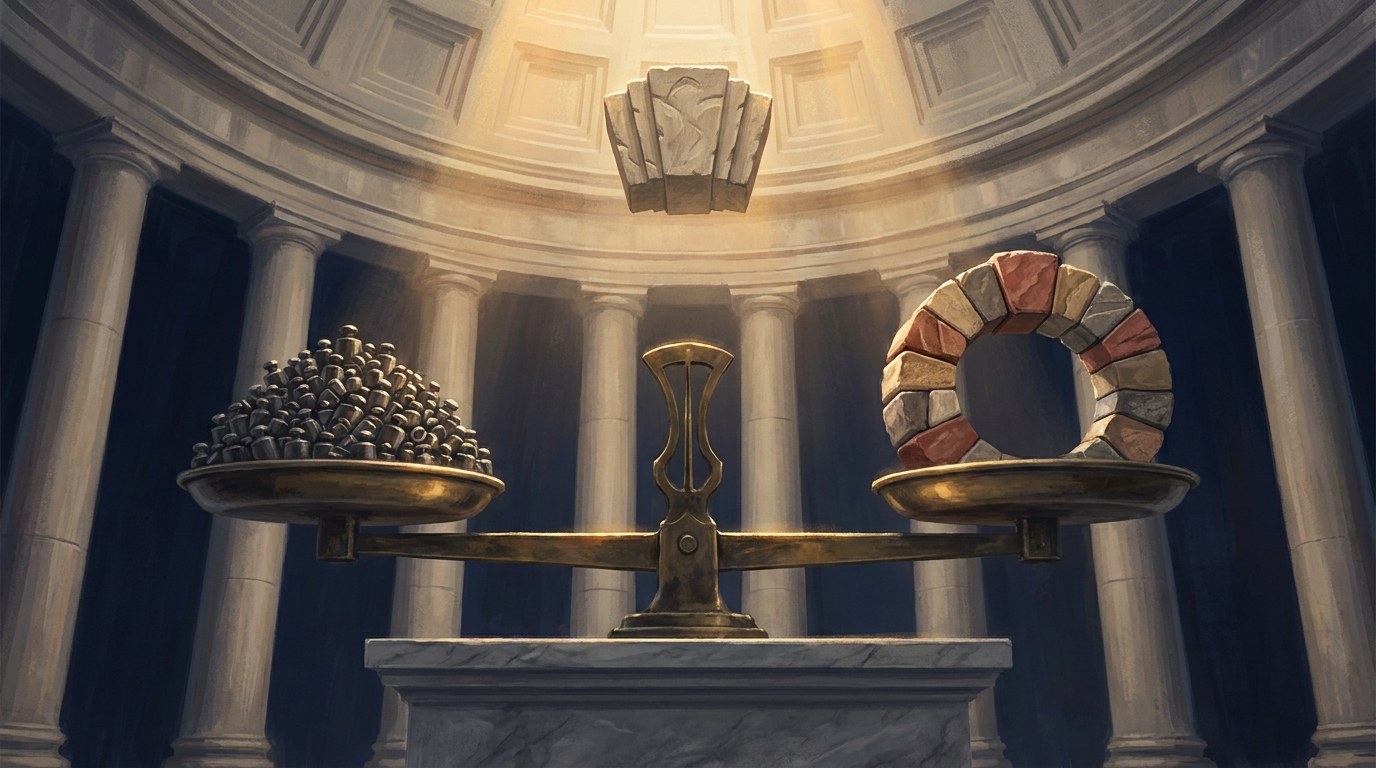
First — the floor: entrench the shares. Write each state's percentage share of the Lok Sabha into the Constitution itself, amendable only by the special majority plus ratification by half the states. Then let the House expand to whatever size modern representation requires. Within each state, one person, one vote, rigorously — every citizen of Uttar Pradesh gains equal representation with every other citizen of Uttar Pradesh, and the House grows to reflect a nation of 1.4 billion. Between states, the federal balance holds — not by a minister's assurance, but by constitutional text no Commission can adjust. This is what April's bill gestured at and refused to guarantee. The gesture failed. The guarantee would not have.
Second — the counterweight: make the Rajya Sabha federal in fact. Rebalance the Council of States toward its name — equal or banded representation for states, real teeth on legislation that touches the federal division of powers. If the lower house must drift toward population over time — and honesty requires admitting that someday, in some measure, it must — then the upper house is where the states' permanent, undiluted voice belongs. Every serious federation learned this. Ours wrote it down and then allocated by headcount anyway.
Third — the ledger: keep money out of the punishment business. The Finance Commission already wrestles with this — its formulas now partially shield states that controlled their populations. Make that shield explicit and permanent. A state's reward for demographic discipline cannot be a smaller share of both Parliament and the treasury. Incentives matter. The republic that punishes the states which answered its call in 1976 will find no state answering its next call — on water, on energy, on climate — in 2036.
That is the whole argument, and it is Rajeev's social justice properly formalised: population alone must not buy power in a federation. Not because northern votes matter less — they do not, and the compact above gives every northern citizen equal weight within an expanded House. But because a union is a promise among its members, and a promise that dissolves the moment one member grows larger than the rest was never a promise at all.
The Lesson
The churning this episode surfaces is a pattern this series has met before.
India's instinct, when confronted with a hard constitutional question, is to freeze it. We froze seat allocation in 1976 and called it a solution. We extended the freeze in 2001 and called it a solution again. Fifty years of postponement have now delivered the question back to us, compounded, with a census already in the field and a deadline the Constitution itself enforces.
Freezes are not solutions. They are loans against the future, and the future has come to collect.
The April defeat bought India one parliamentary term — perhaps less — to do this properly. The government will return with a new bill; the reports say it is already counting votes. If the next version arrives as the last one did — obsolete data, unentrenched promises, reforms held hostage to each other — it deserves the same 54-vote burial.
But if India uses this reprieve to write the real compact — shares in the constitutional text, a federal chamber worthy of the name, a treasury that does not punish success — then April 17, 2026 will be remembered not as the day Parliament said no, but as the day it refused to settle for less than the union deserves.
One person, one vote. One union, many states. The arithmetic can honour both.
It only has to be done in the open, in the text, and on purpose.
Previous Episode: Episode 17: The Language Question Next Episode: Coming soon Series Home: Bharath Manthan
The author is Founder & Editor-in-Chief of BarathVector.