By Ramachandran Rajeev Kumar — 2026-07-09
On the morning of 12 September 2001, for the first and only time in its history, NATO invoked Article 5 — the sacred clause, an attack on one is an attack on all. It was not invoked by America for an ally. It was invoked by the allies, for America. In the twenty years of war that followed, more than a thousand non-American NATO soldiers died alongside Americans; Britain alone buried 642 of its own. That is what the promise looked like when it was called in.
In March 2025, the President of the United States was asked about those same allies. "Do you think they're going to come and protect us? Hmm. They're supposed. I'm not so sure." And of America's own end of the bargain: "If you're not going to pay your bills, we're not going to defend you."
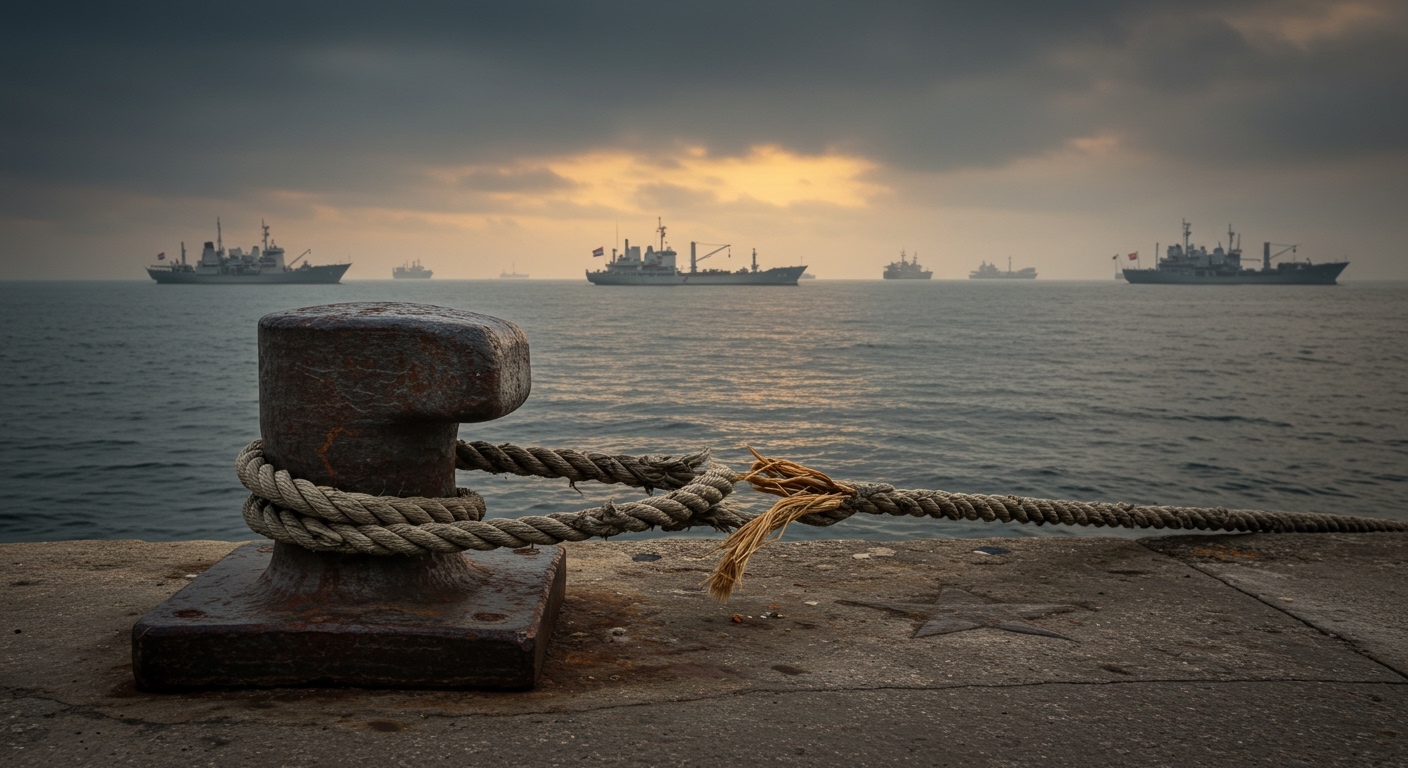
Between those two quotations lies the subject of this article — the quiet demolition of the most valuable strategic asset any nation has ever possessed. Not the carriers, not the dollar, not the eleven-figure defense budget. The trust of nations: the belief, held by governments on every continent, that America would come when called, and that the order America anchored — however often America itself bent its rules — was worth building one's future inside. That trust was the real secret of American power. Under Donald Trump it has been spent down at a speed pollsters have never measured before. And there is a growing, evidence-backed case that it will not come back — not fully, not for anyone, and perhaps not ever.
The secret
Scholars who spent careers studying the American order agree on its architecture. The system built after 1945 rested on two load-bearing conditions: American power, and American willingness to lead. China's rise now strains the first. Trump's politics attacks the second — and the second was always the more important, because it is the one that made the alliances work. What makes NATO and the European Union function, as the political scientist G. John Ikenberry's defenders and critics alike concede, is not paperwork but the high trust among democracies that produces voluntary compliance with common rules. Kill the trust and every institution still stands — hollow, like a temple after the god has left.
When Trump entered the White House in 2017, the United States became, in the words of one reviewer of Ikenberry's work, "the primary critic of liberal internationalism rather than its greatest advocate." The builder picked up the wrecking bar. What follows is the demolition log.
The demolition, term by term
The first term was the rehearsal. Trump repeatedly considered withdrawing from NATO outright and came to the very edge of announcing it at the July 2018 summit — US officials had lawyers study the treaty's exit mechanisms. He made Article 5 openly conditional, musing that he would defend Baltic allies against Russia only if they had "fulfilled their obligations." He walked out of the Trans-Pacific Partnership, the Paris Agreement, and the Iran nuclear deal — each an arrangement America had authored or championed. The alliance survived, scholars later concluded, less through renewed trust than through management: Secretary-General Stoltenberg's flattery and stagecraft, and the fact that American deployments — unlike American rhetoric — held steady. Watch the troops, not the tweets, said the optimists. The world took notes anyway.
The second term is the demolition proper.
Greenland. Through 2025 the President refused, repeatedly and on the record — "I never take military force off the table" — to rule out taking Greenland by force. Greenland is the territory of Denmark: a NATO ally, an EU member, a country whose soldiers died in America's wars. He walked the threat back at Davos in January 2026 after talks with NATO's Secretary-General; by the NATO summit this very week, the White House was again calling the military "an option," and Denmark was vowing to defend its territory. In between, something happened that would have been unthinkable in any prior decade: ten NATO nations, France and Germany and Britain and Canada among them, deployed forces to the Arctic under Denmark's lead — Operation Arctic Endurance — in support of Danish sovereignty; allied soldiers positioning against a threatened American action. The hegemon threatened its own alliance, and the alliance mobilized against the hegemon.
Ukraine. In 2025 the administration sought no new congressional funding for military aid to an ally at war — deliveries continued largely on the previous administration's commitments, and what modest new money there was, Congress appropriated on its own initiative. In July 2025 the Pentagon abruptly suspended Patriot and precision-weapon deliveries in a decision that reportedly surprised even the White House; it was reversed within days, which is somehow worse — a superpower whose left hand does not know what its right hand has stopped. The replacement mechanism, announced that same month, makes the new arrangement explicit: under PURL, NATO allies — not America — pay for all new assistance to Ukraine, more than four billion dollars of it by December. And the United States stepped back from leading the Ukraine Defence Contact Group it had chaired since 2022; Britain and Germany now run it jointly. Consider what that image means: allies replacing withdrawn American leadership inside an American-built structure. The order is learning to operate without its anchor.
Canada. Here the record is almost comic in its cruelty. Against its closest neighbour, longest border, and deepest economic partner, the administration deployed national-emergency tariffs — 25 percent on most goods from February 2025, rising to 35 percent, with 50 percent on steel and aluminum — garnished with musings about the "51st state," about "economic force," about the border as "that artificially drawn line." And then, this month, the culmination: at the pact's mandatory six-year review, Washington refused to renew the USMCA — the trade agreement Donald Trump himself negotiated, signed, and celebrated as the greatest deal ever made — leaving it alive only on an annual-review clock that runs out at its 2036 sunset. "The United States did not agree to renew the USMCA in its current form," said the US Trade Representative, of the US Trade Representative's own agreement. Strip away everything else and keep that one fact, because it is the entire argument in miniature: American commitments no longer survive even the president who made them. Canada's Prime Minister said the quiet part at a podium in the spring of 2025: "The era of close economic integration with the United States has ended… the eighty-year period of US global economic leadership is over." A G7 leader, pronouncing the American era closed, about his own next-door ally.
Behind these headline episodes runs a constant hum of volatility that Europe's own security institute has documented clinically: policy reversals "in a matter of days, if not hours," tariff rates on the EU lurching from 20 to 10 to 30 percent mid-negotiation, sanctions threatened and quietly abandoned after a summit with Vladimir Putin. Alliances are machines that run on predictability. There is none.
The measurement
Opinion is not policy, and approval is not trust — but the polling is the closest thing we have to a fever chart, and it has never looked like this.
Pew's spring 2025 survey of twenty-four countries found US favorability falling in fifteen of them, with collapses of twenty points or more in Mexico, Sweden, Poland — and Canada. Majorities in nineteen of the twenty-four expressed no confidence in Trump. By spring 2026, across thirty-six countries, a median of just 23 percent expressed confidence in his handling of world affairs; American favorability had gone underwater worldwide, 37 favorable against 57 unfavorable. And buried in that survey is the finding that should keep American strategists awake: in not one surveyed NATO member does a majority believe the United States considers their country's interests.
Gallup's numbers are harsher still, because Gallup measures the allies. Median approval of US leadership across thirty-one NATO countries fell fourteen points in 2025, to 21 percent — and the steepest collapses came from the closest friends: Germany down thirty-nine points, Portugal down thirty-eight, with Canada, Britain and Italy close behind. The Nordics, who share an Arctic with a Greenland-hungry America, rate US leadership at 9 and 10 percent. And in 2025, for the first time in nearly two decades by such a margin, the world rated China's leadership (36 percent) above America's (31). Honesty requires the caveats: China has edged ahead before, under Bush and in Trump's first term; among NATO publics the convergence — 22 percent for Beijing, 21 for Washington — is driven by American collapse, not Chinese charm; and on plain favorability the US still outscores China comfortably. But the direction of the river is not in dispute. America's net approval touched minus fifteen in 2025, the lowest ever recorded — below even the trough of 2020.
The verdict of behavior
Polls are what nations say. Budgets are what they believe.
Global military spending hit a record $2.89 trillion in 2025, and Europe drove it: up fourteen percent to $864 billion, the sharpest rise in Central and Western Europe since the Cold War ended — Germany up 24 percent, Spain up 50, the EU assembling a rearmament envelope of up to €800 billion, NATO adopting a five-percent-of-GDP pledge at The Hague. A SIPRI researcher stated the cause without diplomatic padding: allies are spending "due to growing uncertainty over U.S. support." They are arming because they doubt America will show up. Fairness requires the co-author of this surge to be named — Vladimir Putin's war supplied the fear. But fear of Russia used to drive allies toward American weapons and American guarantees. Now it drives them toward their own: Germany's new procurement plan allocates just eight percent of its budget to US systems, a deliberate firewall against American politics. Denmark's military intelligence has, for the first time, labeled the United States a potential security concern; its parliament's defense committee chair regrets buying the F-35 — "we must avoid American weapons if at all possible" — and Copenhagen chose the Franco-Italian SAMP/T air-defense system over the American Patriot after the Greenland threats. European planners now war-game a fear that would once have been paranoid fantasy: that Washington might impose use-restrictions on American-supplied arms in the middle of a war with Russia.
The pattern repeats in every currency of power. In trade: the CPTPP — the pact the remaining eleven rebuilt after Trump abandoned its American-designed predecessor — opened formal dialogue with the EU in November 2025, and by March 2026 the two blocs were jointly sponsoring WTO negotiations. The rules-based order is learning to legislate around its founder. In money: the dollar index fell eight percent in the opening months of the second term while foreign investors sold off American equities — signals, not yet a trend, but signals pointing one way. And in the most dangerous ledger of all: a record 76.2 percent of South Koreans now favor building an independent nuclear arsenal — support that survives even when pollsters spell out the costs — after an American National Security Strategy that did not mention North Korea at all. When the umbrella looks rented, nations begin shopping for their own.
The honest turn
Now the argument against this article, stated at full strength, because BarathVector does not bury counter-evidence.
Trust rebounded before — spectacularly. Across the twelve nations Pew surveyed in both years, confidence in the US president leapt from a median of 17 percent in Trump's last year to 75 percent in Biden's first. Gallup's NATO series shows the same sawtooth: down under Trump, up under Biden, down again. The US recovered from the Bush-era lows of 2007–08. It recovered, eventually, from worse than polling: from Iraq — which a former US Under Secretary of State called "the single greatest blow to American power and prestige since Vietnam," a war justified by claims that were, in his words, blatantly and inexcusably wrong — and from Abu Ghraib, and from Guantanamo.
And honesty compels this article to concede more: America was never an innocent steward of its own order. The paralysis of the WTO's highest court began not with Trump but with Obama's blockade of appellate appointments, and continued under Biden — a bipartisan strangling of the very dispute system Washington designed. The realist critics are right that the order never truly restrained American power, and Ikenberry himself — the order's chief academic defender — concedes that liberal internationalism "has dirty hands."
So why did the trust survive Iraq and die now? Because the world trusted America not for following the rules, but for wanting the rules to exist. Iraq was a violation inside the temple; the violator still knelt at the same altar, and every president of both parties since 1945 had done so. What Trump announced — "if you're not going to pay, we're not going to defend you" — is that the temple was a protection racket all along. Nations forgave the hypocrite who believed. They will not forgive the landlord who doesn't.
And here is the pivot on which the whole question turns. Look inside that glittering 2021 rebound: at its very peak, with a devoutly Atlanticist president promising America was back, a median of just 11 percent of allied publics called the United States "very reliable." Two-thirds still said America ignores their interests. The mood recovered; the faith did not. The allies had already learned the lesson of 2016 — that everything an American president promises is one election from erasure — and they hedged accordingly, and in 2025 the hedge paid out. Political scientists have now given the mechanism a name and a prognosis: the collapse of the bipartisan foreign-policy consensus, institutional decay, and polarization are, in the words of one peer-reviewed assessment, "long-term trajectories that will not disappear even if a more internationalist president is elected in 2028." The EU's own security-studies institute has put the conclusion in print, hedged but unmistakable: this time, "the erosion of transatlantic trust might be permanent." Europeans, its researchers observe, increasingly regard America as a necessary partner — no longer a trusted ally.
That phrase is the tombstone. Trust that resets every four years is not trust. It is weather.
The view from India
No country illustrates the arc more sharply than ours — because no major country liked Trump more.
Remember the affection. Howdy Modi in Houston, Namaste Trump in Ahmedabad, and numbers to match: in Pew's spring 2025 survey India stood among a mere handful of nations — five in all — where about half or more expressed confidence in Trump, at 52 percent. One year later: 39. India has fallen off the list of countries giving Trump his best ratings, American favorability here has dropped to 45 percent, and 31 percent of Indians now view the United States unfavorably — the highest negative rating Pew has recorded in India since its tracking began in 2002. Among Indian Americans, approval of the president's handling of US-India relations has fallen to 20 percent, from 48 under Biden. Just 18 percent of Indians approve of his tariff policy. The most pro-American major public on earth took one year of the second term to change its mind.
What changed it is no mystery. The tariffs came — 50 percent by August 2025, for a time higher than China's. The Kashmir mediation offer came, in May 2025, and New Delhi flatly refused it; the partner of two decades of "natural allies" rhetoric had treated India's core sovereign concern as a bargaining chip. And the American dream itself was repriced: a $100,000 fee on the H-1B visa — a program in which Indians were 71 percent of new petitions — plus interview suspensions, social-media vetting, and thousands of revocations. The results were immediate and historic. Student visas issued to Indians collapsed 69 percent in the decisive June–July window of 2025 — 82 percent below the 2023 peak — and for the first time since 2021, more Chinese than Indian students received them. The number of Indian students in America, per data laid before our own Parliament, has begun to fall. American universities themselves blame their government's policy, overwhelmingly and on the record. Let precision temper the rhetoric: India remains the largest student community in the United States, some 363,000 strong, and most Indian-American families would still recommend the journey. America is not "no longer a destination." But it is no longer the default — applications are staying home, preferences have shifted, and a University of Pennsylvania study supplies the delicious arithmetic: every rejected H-1B produces roughly half a hire abroad, most often in India. America's wall is our repatriation programme.
Fairness requires the other ledger, and it is substantial. Even amid the tariff war, the two governments signed a third ten-year defense framework in October 2025; the COMPACT initiative launched in February 2025; joint exercises barely slowed; cumulative Indian purchases of American arms stand near $25 billion. And in February this year came the detente — tariffs down to 18 percent, an interim trade agreement, America still our largest trading partner at over $210 billion. But read the terms of that reconciliation: it was bought with an Indian commitment to halt Russian oil purchases and a $500 billion buying pledge. Even the making-up was transactional. That is precisely what "necessary partner, not trusted ally" means, and India has learned to say it in the same breath as Europe.
Then came June, and the lesson that settled the matter. When Washington concluded its memorandum with Iran — a deal that, as we publish, already lies in ashes — it did so with Israel, its closest, loudest, most congressionally armored ally, sidelined to the point that Israeli officials said they had not been allowed to review the final text. The deal imposes obligations on Israel without Israel's signature: its ceasefire covers the fighting with Hezbollah, and it requires Israeli withdrawal from Lebanon under any final arrangement. Netanyahu's adviser declared Israel unbound by those provisions; the American President, for his part, publicly disparaged the Israeli Prime Minister's judgment in language we will not reprint. This article does not adjudicate the deal's merits, and the timeline deserves precision — as recently as February, in Jerusalem, Modi and Netanyahu were praising Trump's Gaza ceasefire plan together. But for Indian strategists the June spectacle answered the only question that matters: if Washington will impose terms on Israel without showing it the text, what would an American commitment to India be worth? Only 28 percent of Indians approve of Trump's Iran approach. The Indian public has done the arithmetic.
Let it be said plainly where this newspaper stands, and where it does not. India does not endorse the extreme character of Israel's repression in its wars against Hamas and Hezbollah — and Indians did not fail to notice that the Prime Minister's February visit drew criticism at home, amid a Gaza war whose reported toll has passed seventy thousand. But beneath the disagreement over methods runs an understanding that no Western capital can quite share: decades of terrorism parceled as jihad, the lies, the manipulation of fact, the murder of innocents beneath a pretext of religious superiority. The patterns that face the two nations are similar to a degree that is undeniable; the responses have been poles apart, as Kashmir's long restraint shows. In February the two governments put the kinship in writing, twinning October 7 and Pahalgam in a single joint statement.
And Pahalgam is why the restraint should not be mistaken for a permanent condition. When 26 civilians were murdered there in April 2025, India's answer was Operation Sindoor: strikes on the headquarters of Lashkar-e-Taiba at Muridke, Jaish-e-Mohammed at Bahawalpur, Hizbul Mujahideen at Muzaffarabad — a hundred terrorists dead by our government's account — and a doctrine declared in the open: any act of terror is an act of war. Sindoor, officially, is paused — not concluded. The days of half-hearted, deniable, diplomatically calibrated responses are over; disproportion is now the deterrent, and every preparation for it has doubled with Israel as strategic partner. The evaporation of the pretense of an American umbrella — an umbrella that, for India, never actually existed — has only added fuel. The proof is in metal: a record ₹1.78 lakh crore of defence production last fiscal year and exports up 63 percent to over eighty countries, by the Defence Ministry's own accounting; a MIRV-capable Agni tested in May, with a 10,000-kilometre Agni-6 awaiting only clearance; a ₹1.25 trillion second semiconductor mission moving through approval. Who stands with India when it hardens? Israel, proven. Russia — to an extent, and a shrinking one: still our largest arms supplier, but down from seventy percent of our imports a decade ago to forty, its S-400s running two years late, and its oil now bargained away in our own detente with Washington. Japan, in this newspaper's judgment, may soon join as the next trustworthy partner. Washington is on the list of markets, not the list of brothers.
Honesty about ourselves, finally, because self-congratulation is how nations stay weak. India's fighter fleet still hangs on foreign engines. The GE F414 for our next-generation aircraft now costs over $24 million a unit; the co-production agreement remains unsigned as of last month; the F404 deliveries for Tejas have slipped repeatedly while squadrons thin; and the alternatives under study are European — imports by another name. Decades of comfortable dependence bought this gap. It is the strongest argument for the acceleration, written in our own ledger.
What is not coming back
A closing word to those in Washington who assume, as Americans always have, that the world will forgive and reset — that 2028 can do what 2021 did.
It may. The polls may recover; they have before. But the eleven percent will not become ninety, because the world has now watched the cycle twice, and nations do not extend real trust to a coin flip. Every ally is building the capability to survive American absence; every hedge, once built, is permanent, because no defense ministry dismantles insurance. Europe will keep the factories. Korea will keep the enrichment debate. India will keep the doctrine, the missiles, and the friends who bleed the way we do.
The tragedy is not that America became weak. It is that America, still the strongest nation on earth, voluntarily liquidated the one asset strength cannot buy back. The trust of nations was accumulated across eighty years, two world-war debts, a Marshall Plan, and a single invocation of Article 5 on a September morning — and it was spent in a decade of tweets, tariffs, and torn-up signatures, many of them the president's own.
India's conclusion is the world's, in miniature: build as if no one is coming, partner with those who understand your wounds, and treat every American promise as what the American electorate has made it — weather. Bright some mornings, brutal others, and never, ever a foundation.