By Ramachandran Rajeev Kumar — 2026-09-30
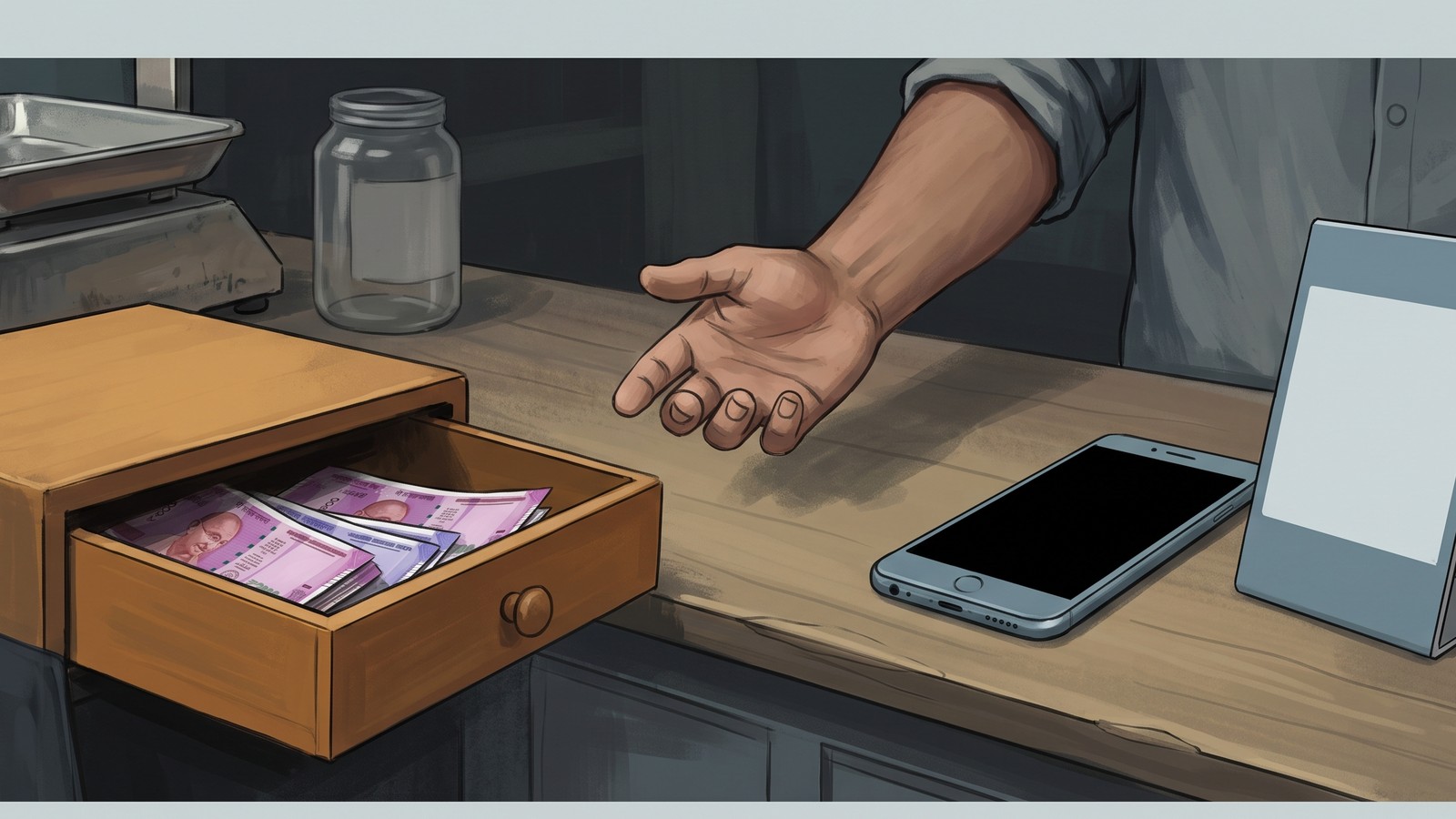
A shopkeeper chooses a payment method by what remains of the sale, not by how its fee compares with a credit card's. Charge him for UPI, and cash begins to look better.
From Oct. 15, the government plans to introduce a merchant discount rate of 0.4 percent on specified person-to-merchant UPI payments. On a ₹3,000 sale, the finance ministry's own example puts the charge at ₹12. That sounds small until it is compared with profit rather than the sale price.
At a hypothetical 2 percent net margin, that shop would keep ₹60 before the fee. Paying ₹12 to accept UPI takes one-fifth of it. The margin is an illustration, not a claim about every shop; the incentive is real.
This is where the policy starts from the wrong end. UPI needs money to run securely. The question is not whether its banks and payment companies should be paid. It is how much can be charged at the counter before the counter starts choosing cash.
Who actually pays
The exemptions are substantial and deserve to be stated plainly. Person-to-person transfers remain free. Merchant payments of ₹2,000 or less remain free. The Department of Financial Services' Sept. 15 FAQ says eligible micro-merchants in the P2PM category, receiving up to ₹1 lakh a month through UPI, retain zero MDR even when an individual payment exceeds ₹2,000. A bank moves a merchant who exceeds that monthly threshold for three consecutive months into the regular merchant category, according to the same document.
Fuel, rail, telecom and some other designated payments above ₹2,000 face a flat ₹5 charge rather than the standard percentage. Transactions of ₹75,000 and above have a ₹300 cap.
The government says more than 95 percent of merchant-payment transactions by number are worth ₹2,000 or less. That protects everyday purchases. But transaction count does not tell us what share of merchant takings will attract the fee, or how thin the margins are on those sales.
A vendor can cross ₹1 lakh in monthly UPI receipts without being a large business. The exemption is a line drawn across payments, not a test of a shop's capacity to absorb a new cost.
The ministry also says the customer must not be charged directly. A merchant who cannot add a UPI surcharge still has choices: absorb the cost, trim a discount, prefer cash for a larger bill, or stop offering UPI on that bill. A prohibition on passing through a fee does not erase the economics that make those choices attractive.
The return trip to cash
The warning is not a theory invented for this column. Kumar Rajagopalan, chief executive of the Retailers Association of India, told Business Today that after expenses some retailers earn net margins of 2 to 3 percent and that smaller merchants would think twice about the 0.4 percent charge. MediaNama has reported opposition from retail bodies and shop notices warning that UPI may not be accepted for higher-value purchases.
Those are warnings and stated intentions, not evidence that millions of payments have already moved to cash. The fee is not due to begin until Oct. 15. Nor will every shop make the same choice: some can absorb it, and cash has costs in handling, security and banking.
But the government does not need every shop to leave UPI for the policy to work against its purpose. A shift among the merchants and transactions that face the charge would weaken the digital payment trail it spent years building.
Start lower and watch the counter
There is a serious case on the other side. The finance ministry says the money will support payment infrastructure, fraud prevention, cybersecurity and customer service. A network that moves billions of payments cannot run on a wish. Payment providers argue that revenue can help fund reliability and expansion. It would be convenient, and unserious, to demand a permanently free system without saying who pays for it.
But 0.4 percent is a starting price, not a law of nature. The government could have begun with a lower percentage on the same eligible transactions. Publish how much that raises for the network, then watch what happens to payment acceptance before increasing it.
Compare similar merchants' high-value UPI volumes and surveyed cash receipts before and after the change. Publish the method, not just a claim that 95 percent of transactions remain free. If the lower rate fails to cover a defensible share of system costs, show the shortfall and make the case for the next step. If merchants keep accepting UPI, the government will have earned room to raise the rate. If they do not, it will have learned cheaply.
The Supreme Court declined on Sept. 28 to stay the proposed framework while asking the Centre, the Reserve Bank of India and the National Payments Corporation of India to respond to a challenge. That was not a ruling that the charge is economically wise, or a final decision on its legal basis. The policy can still be improved without waiting for the court to do the finance ministry's work.
India made UPI ordinary by making it easier for a shop to take a digital payment than to count change. That habit has value beyond any one transaction. It is easier to raise a low fee on payments merchants still accept than to bring them back to the QR code after they have put it away.