By Ramachandran Rajeev Kumar — 2026-07-06
Bharath Manthan - Episode 15
By Ramachandran Rajeev Kumar
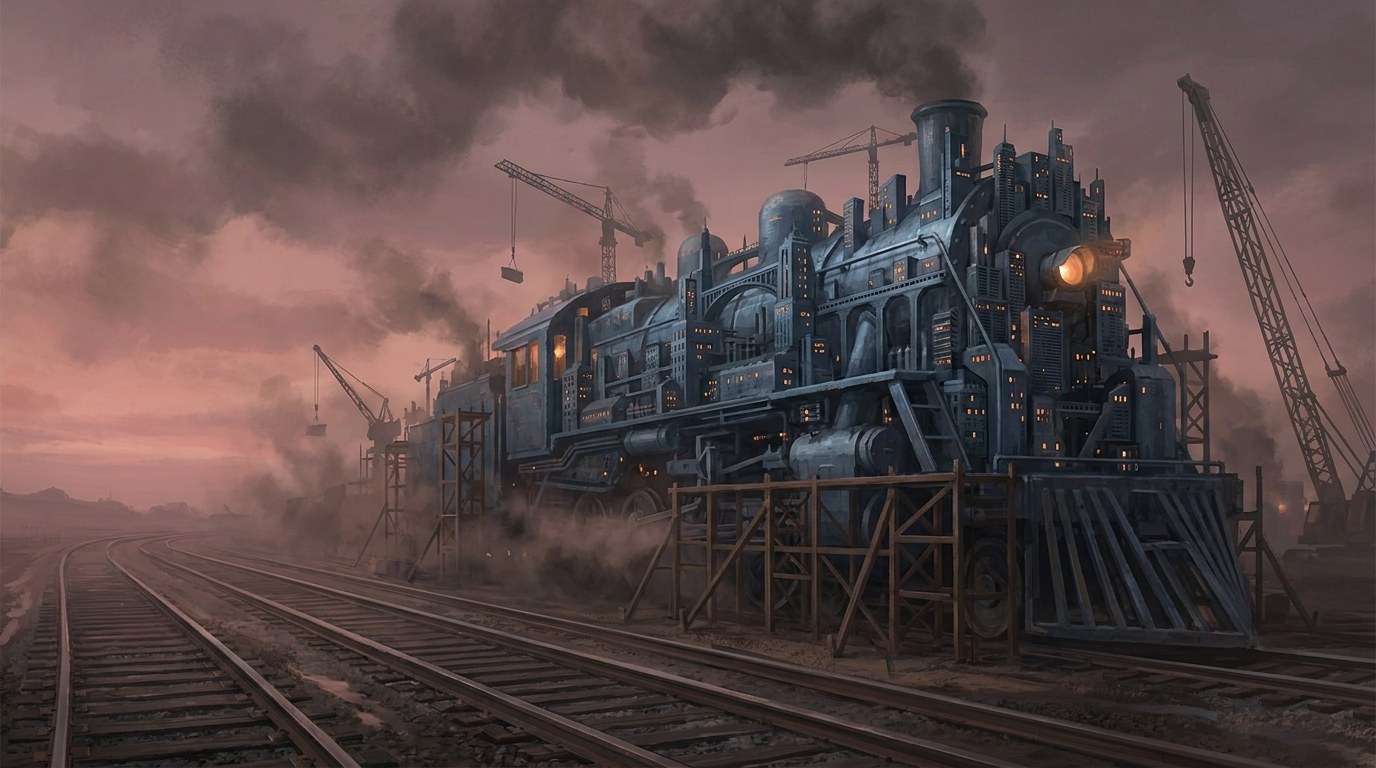
The Unbuilt Engine: Why India Starves Its Cities
Two-thirds of the economy, run on less than one paisa in the rupee
Begin with the arithmetic, because the arithmetic is the argument.
Indian cities generate roughly 63% of the country's GDP. NITI Aayog expects that share to approach 75% by 2030. Every engine of the growth story - the IT campuses, the pharmaceutical clusters, the financial district, the startup ecosystem, the port, the airport - sits inside a city.
Now the other side of the ledger. The Reserve Bank of India's Report on Municipal Finances puts the revenue of India's municipal corporations at 0.6% of GDP. The central government commands 9.2%. The states command 14.6%.
Read those numbers again. The tier of government that hosts two-thirds of the economy runs on six paise out of every hundred rupees of public revenue - less than one paisa in the rupee of national income.
No other major economy runs its cities this lean. Financial transfers to municipal governments amount to about 0.45% of GDP in India. In Brazil, Indonesia, the Philippines and Mexico, the equivalent figure ranges from 1.6% to 5.4%. In much of Europe, 6% to 10%.
We are attempting something no country has managed: getting rich through cities while refusing to govern them.
The One-Paisa City
Where does a municipal corporation's money come from? Mostly, from someone else.
The RBI finds that own tax revenue - property tax and local levies - accounts for barely a third of municipal income. Own sources of every kind - taxes, fees, user charges - cover only about half. The rest arrives as grants and transfers from the state and the Centre, with strings attached and elections in mind.
The one tax that should anchor city finance tells the story best. Property taxes of every kind collect around half a percent of GDP in India - and the municipal slice of that is a fraction. South Africa manages 1.4%. Brazil, 1.3%. China, 1.7%. The United Kingdom and France, above 4%. Indian cities sit on some of the most valuable urban land on earth - Mumbai real estate rivals Manhattan - and tax it like a village fair.
It was not always this bad. Octroi - the tax on goods entering a city - was crude, corrupt and inefficient, but it was buoyant, and it belonged to the city. Mumbai's municipal corporation, the country's richest, was built on it - nearly seven thousand crore rupees a year. GST subsumed octroi in 2017 and replaced a city-owned revenue stream with a compensation cheque signed in the state secretariat.
A government that cannot raise its own money is not a government. It is a branch office.
And a branch office cannot borrow. The municipal bond market that financed American and European urbanisation barely exists here, because you cannot issue bonds against a balance sheet that is 70% someone else's grants. The engine cannot leverage its own future because it does not own its present.
The Amendment That Asked Politely
The Constitution knows what a city government should do. The 74th Amendment, passed in 1992, listed 18 functions in the Twelfth Schedule: urban planning, land use, water supply, public health, slum upgrading, fire services, and more.
But read the operative clause. Article 243W says state legislatures may endow municipalities with the powers needed to function as institutions of self-government.
May. Not shall.
The 74th Amendment did not devolve power to cities. It asked state governments - the very institutions that would lose power - whether they would like to give some away. Thirty-four years later, we have our answer. Most states have never transferred the full 18 functions. What was devolved was often the burden without the budget: the city keeps the drains, the state keeps the development authority.
Look at who actually runs an Indian city:
- Planning and land sit with a Development Authority answerable to the state government - the DDA in Delhi, the BDA in Bengaluru.
- Water sits with a Jal Board or a state water utility.
- Transport sits with a state transport corporation, and the metro with a special-purpose company jointly owned by Delhi and the state.
- Police, unlike in almost every major democracy, answer to the state home department. No Indian mayor commands even a traffic constable.
The mayor - the one figure a citizen can name and blame - is in most states a ceremonial chain worn for ribbon cuttings, elected indirectly, serving terms as short as one year, outranked in practice by an IAS municipal commissioner who reports to the state capital. The Metropolitan Planning Committees the Constitution mandates for large cities exist mostly on paper.
The result is a machine designed to be unaccountable. When Bengaluru floods, the corporation blames the development authority's layouts, the authority blames encroachments on lake beds it does not police, the water board blames storm drains it does not own, and the citizen - who pays all of them - can vote none of them out. Fragmentation is not a bug of this system. It is the design.
The Cities That Officially Do Not Exist
It gets stranger. A large share of urban India is not legally urban at all.
The 2011 Census counted nearly 3,900 "census towns" - settlements that are urban by every measurable criterion (population, density, non-farm employment) but are still governed as village panchayats. The number had almost tripled in a decade. The 2027 Census will almost certainly reveal thousands more.
These are places with factories and apartment blocks administered by bodies designed for fields and wells - no building codes worth the name, no fire service, no planned water supply. Research confirms the obvious: settlements that get municipal status early build measurably better public infrastructure than those left waiting. We leave them waiting anyway, partly because rural bodies attract central scheme money and municipal status brings taxes - a perverse incentive to stay officially a village while becoming actually a city.
And who will plan these places? India has roughly one qualified urban planner per 100,000 people. The ratio in developed countries is closer to one per 5,000. NITI Aayog's own 2021 report on urban planning capacity found the cadre thin, the sanctioned posts vacant, and the plans - where they exist - decades stale. Most Indian cities are not badly planned. They are simply unplanned, in the strict sense that no one with the authority and the training ever sat down to plan them.
Three deficits, then, stacked on top of each other: cities without money, cities without power, and cities without planners. That is the unbuilt engine.
The Honest Complications
Every argument this clean deserves its complications stated plainly.
First: states are not wrong that many municipal bodies are weak. Corporations that cannot collect the property tax already due to them, whose accounts are years in arrears, make an easy case against giving them more. But this is a chicken with a well-documented egg. Institutions acquire capacity by exercising power, not by waiting in line for it. We did not deny state governments their powers in 1950 until they proved themselves worthy; we assumed the exercise of responsibility would build the muscle. It did.
Second: the state capitals do invest in cities - selectively, spectacularly, and from above. The metros, the expressways, the riverfront projects. What arrives from above is what photographs well from above. What only a city government would prioritise - drains, footpaths, primary health centres, working streetlights on the street you actually live on - is precisely what the current structure starves.
Third: devolution is no panacea. Empowered cities can be captured by builder lobbies as easily as state governments are. The difference is proximity: a captured municipal government is at least captured within walking distance of its victims, who can see it, name it, and unseat it.
The City Has No Lobby
Why does this persist? Because in Indian politics, the city is everyone's cash cow and no one's constituency.
A chief minister's arithmetic is rural. The city generates the revenue that funds the farm loan waiver; empowering the city means losing discretion over both. No CM has ever been re-elected for strengthening a mayor who might grow into a rival. The incentives all point one way, and they have pointed that way since 1992.
The voters who might force the issue are missing too. Tens of millions of migrants work in cities but vote - when they vote at all - in the villages their ration cards remember. The city's true population and its electoral population are different numbers.
And this April, when Parliament fought its great war over representation - the delimitation battle this series will return to - notice what nobody mentioned. Urban constituencies are the most under-represented seats in India. Malkajgiri, on Hyderabad's edge, packed nearly 3.8 million electors into one Lok Sabha seat at the 2024 general election - the largest electorate in the country, and more than twice the national average. Fifty years of frozen boundaries have quietly disenfranchised the Indian city dweller more than any other citizen, and in the entire April debate - north versus south, 2011 census versus 2027 - the word "urban" barely surfaced.
The farmer has a lobby. The state has a lobby. Industry has a lobby. The city - where all three meet and prosper - has none.
What Building the Engine Would Take
None of this requires constitutional genius. It requires the will to finish a sentence written in 1992.
Make devolution mandatory. Amend Article 243W's may to shall, with a timeline. The 18 functions of the Twelfth Schedule, transferred with the funds and the staff that go with them.
Directly elected mayors with five-year terms in the major cities, with the commissioner answering to the mayor, not the state secretariat. One person to credit. One person to blame.
Let cities tax like governments. Property tax reform - GIS mapping, unit-area methods, ruthless collection - could triple municipal own revenue without a single new tax. Add land value capture around metro stations and highways, so the public purse recovers a share of the value the public's infrastructure creates.
Municipalise the census towns. Automatic, criteria-based conversion when the census says a place is urban - no state discretion, no decade of limbo.
Constitute the metropolitan governments the Constitution already promises for the five or six great agglomerations, with authority over the parastatals - because Mumbai's problems do not respect the corporation's boundary, and neither should its government.
Staff the future. Planner cadres in every state, planning schools scaled to a 1:10,000 ratio, and State Finance Commissions constituted on time and heeded.
Six items. Every one of them proposed before, by commission after committee after report. The shelf groans with the diagnosis. Only the politics is missing.
The Lesson
There is an old romance at the root of this, and it deserves to be named.
"India lives in her villages," we were taught, and in 1947 it was true. The Constitution's makers wrote local government into the states' domain and moved on; the village republic acquired mythic status while the city remained, in the national imagination, a necessary evil - crowded, corrupting, un-Indian.
By 2036, some 600 million Indians will live in urban areas. The village will remain the soul of one India. But the surplus that must fund every national ambition - the defence budget, the welfare state, the energy transition, Viksit Bharat itself - will be earned in the cities, by the cities.
A civilisation that built Mohenjo-daro's drains four thousand years before Europe managed sewers has spent seven decades pretending it is not urban. The engine of the Indian century is sitting in plain sight: sixty-three paise of every rupee, governed with six.
The churning, as ever, offers poison and nectar together. The poison is the comfortable myth that someone else - the state, the Centre, a mission, a scheme - will govern the cities for us. The nectar is the oldest lesson of self-government: those who create the wealth, and live with the drains, govern best.
We wrote that lesson into the Constitution in 1992. We have spent thirty-four years refusing to read it.
Previous Episode: Episode 14: The Ladder and the Racket
Next Episode: Episode 16: The Water Ledger
Series Home: Bharath Manthan - Churning the Indian Pot
Ramachandran Rajeev Kumar is the founder of BarathVector. Agree? Disagree? The churning continues in the comments.