By Ramachandran Rajeev Kumar — 2026-07-06
The Water Ledger
Bharath Manthan - Episode 16
By Ramachandran Rajeev Kumar
Every civilization keeps books. Ours has stopped reading them.
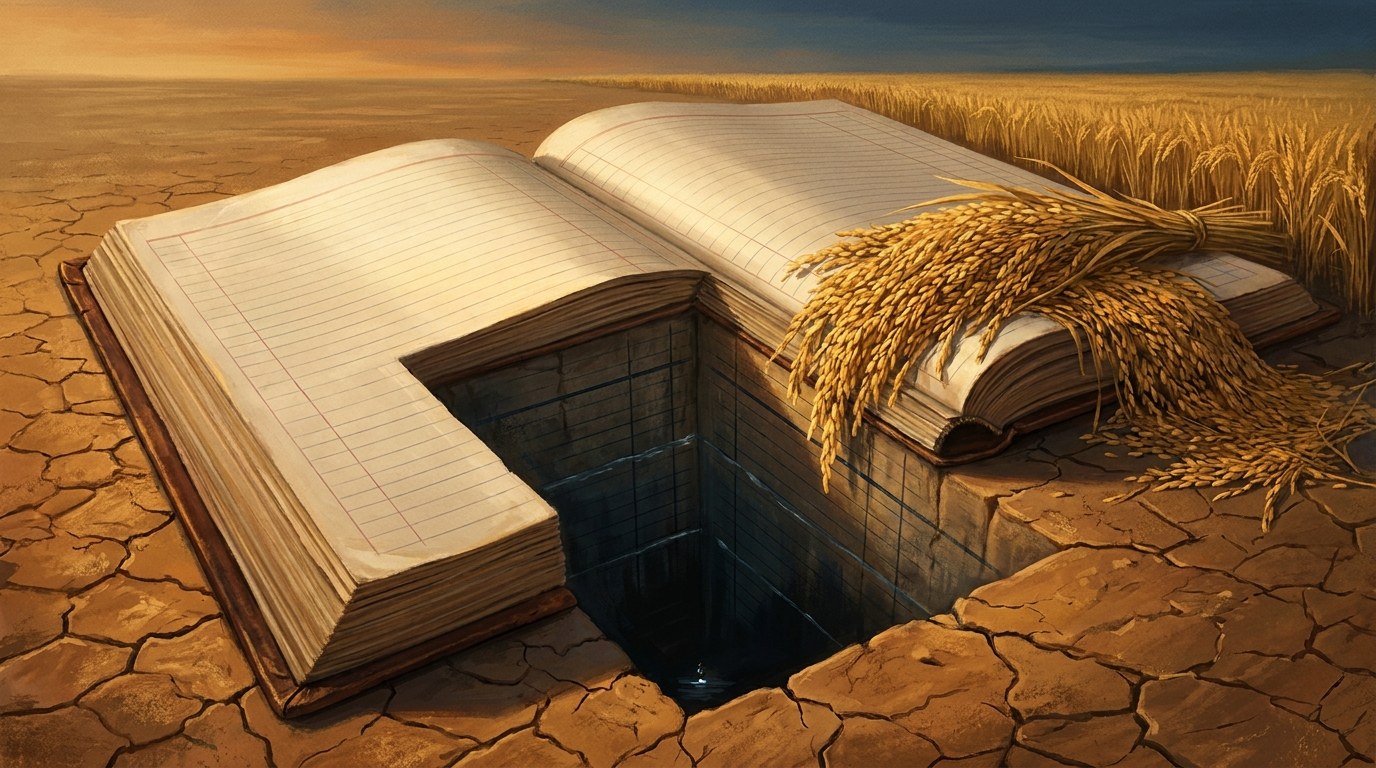
Every enterprise, however grand, obeys one rule of accounting: you cannot spend more than you earn forever. You can do it for a while - on credit, on inventory, on the patience of your creditors. But the ledger keeps score even when you stop looking at it.
A nation's groundwater is an account. Rain and rivers make deposits. Tubewells make withdrawals. The Central Ground Water Board is, in effect, the nation's auditor, and its latest annual audit - the Dynamic Ground Water Resource Assessment of 2025 - reads, at first glance, like a healthy balance sheet.
India's annual recharge: 448.52 billion cubic metres. The amount we may safely draw: 407.75 BCM. The amount we actually drew: 247.22 BCM. Nationally, we spend about 61 paise of every rupee of water income.
Solvent. Comfortable, even.
Now turn the page.
The Comfortable Lie of the Average
The national average is where inconvenient truths go to be diluted.
The auditor assessed 6,762 units - blocks, mandals, talukas - across the country. Of these, 730 are classified "over-exploited": they withdraw more every year than nature deposits. They are not distributed randomly. They are concentrated in the northwest, the west, and parts of the south - which is to say, in the exact geographies where India grows its surplus food and drills for its drinking water.
And at the centre of the red ink sits Punjab.
Punjab's account earns roughly 21 BCM a year in recharge. Punjab spends roughly 34 BCM. That is an overdraft of about 14 BCM, every year, year after year. The water table falls by roughly half a metre annually. Nineteen of the state's 23 districts are officially "dark zones." The CGWB's assessment, as reported this year, carries a sentence that should be read aloud in Parliament: at current rates of extraction, Punjab's usable groundwater is finished in about 14 years.
Fourteen years is not a projection. It is an amortisation schedule.
A child entering Class 1 in Ludhiana this month will, on present course, finish college in a state that has pumped its last accessible aquifer dry.
How the Overdraft Was Engineered
Here is what this episode will not do: blame the farmer.
The Punjab farmer is not irrational. He is arguably the most rational economic actor in India. He grows rice in a semi-arid state for the same reason anyone does anything twice: because it pays, reliably, every single season.
Consider the incentives we built for him.
First, the guarantee. Paddy in Punjab enjoys what almost no other crop in India enjoys - effectively complete procurement at the Minimum Support Price. Whatever he grows, the state buys. No other crop offers that certainty. Maize does not. Pulses do not. Cotton does not.
Second, the free fuel. Since the late 1990s, electricity for farm tubewells in Punjab has been free. The cumulative bill for that policy has crossed Rs 1.34 lakh crore. Free power means the marginal cost of pumping water from 100 feet, then 200 feet, then 300 feet, is zero. When something is free, the ledger stops working - price is how a ledger speaks, and we cut its tongue out.
Third, the mandate. This arrangement is not an accident of state politics. It is national food policy. Punjab - 1.5 percent of India's land - supplies close to a third of the rice and nearly half the wheat in the central procurement pool. The Green Revolution asked Punjab to feed India. Punjab said yes. It has been saying yes for sixty years, and it has been paying for that yes in water.
Rice in Punjab is not a crop. It is a policy instrument that happens to photosynthesize.
So when Delhi's commentators sigh about Punjab's "unsustainable cropping pattern," let us be precise about authorship. The pattern was designed. The MSP was set in Delhi. The procurement is central. The free power was competitive state politics, tolerated by every party that promised to end it. Every rupee of the overdraft was authorised.
One Ledger, Three Crises
In 2009, Punjab tried a correction - the Preservation of Subsoil Water Act, which barred paddy transplanting before mid-June so that the crop would lean on monsoon rains instead of April's tubewells.
It saved some water. It also compressed the harvest into a narrower window at the end of October - leaving farmers three weeks, not six, to clear stubble before sowing wheat. The cheapest way to clear stubble in three weeks is a matchstick.
Follow the smoke southeast and it arrives, every November, over Delhi.
This is the thing about ledgers: entries do not stay in their columns. A water policy became an air-quality emergency. A power subsidy became a fiscal haemorrhage. An MSP schedule became a public-health statistic in a paediatric ward in east Delhi. One account, three overdrafts, and everyone auditing their own column while the book bleeds as a whole.
The Export Column
Now for the entry almost nobody reads.
Producing one kilogram of rice consumes roughly 3,000 litres of water - estimates run from 2,500 to 4,000 depending on region and method. When India exports rice, that water travels with it, invisibly. Economists call it virtual water. An accountant would call it what it is: a withdrawal.
India is the world's largest rice exporter - over 40 percent of the global trade. By one recent estimate, the water embedded in our 2023-24 rice exports was about 40.87 BCM. That single export line equals roughly 17 percent of India's entire annual groundwater extraction, for all purposes, for 1.4 billion people.
And where does export rice come from? Overwhelmingly from Punjab, Haryana and western Uttar Pradesh - the very districts the CGWB classifies as over-exploited.
Read that ledger honestly and the transaction is this: India is exporting its aquifers at commodity prices. We drain a resource that took millennia to accumulate, embed it in a grain, and sell it abroad at a few hundred rupees per thousand litres of irreplaceable water. Basmati at least earns two to two-and-a-half times more per kilogram - more value per litre. The non-basmati bulk trade is the aquifer leaving the country at clearance-sale rates.
No finance minister would tolerate this arithmetic in foreign exchange. We have tolerated it in water for decades.
The Poison Column
There is a second book, grimmer than the first. It tracks not how much water remains, but what the remaining water contains.
After the last monsoon, 62.5 percent of groundwater samples tested in Punjab exceeded the safe limit for uranium - up from 32.6 percent just a year earlier. In Sangrur and Bathinda, readings crossed 200 parts per billion, nearly seven times the limit. The CGWB's Annual Ground Water Quality Report for 2025 describes what it calls a multi-contaminant emergency - uranium, heavy metals, nitrates, fluoride - across multiple regions, as receding water tables concentrate what remains and pull in what should never have been touched.
This column matters more than the depletion column, for one reason: scarcity can be rationed. Poison cannot. A dry well is a tragedy with workarounds - tankers, pipelines, migration. A poisoned aquifer under a populated plain is a problem with no administrative solution at any price.
What the Honest Books Actually Say
Bharath Manthan does not deal in doom, so let the record show the credit entries too.
Nationally, the trend is improving. Since 2017, annual recharge has risen from 432 to 448.52 BCM. The share of over-exploited units has fallen from 17.2 percent to 10.8 percent. Nearly three-quarters of assessed units are now "safe." Recharge structures, watershed work, and better monsoons have moved real numbers in the right direction.
This is the most important line in the audit, and the least quoted: the damage is a policy artefact, and policy artefacts can be repaired. Where incentives changed, aquifers responded. Water is not oil. The account refills - if you stop treating drawdown as income.
Which brings us to the only question that matters.
The Transition Price
Everyone in this debate knows the destination: Punjab must grow less paddy. The state government knows it. The Union knows it. The farm unions know it. The CGWB has been publishing the arithmetic for twenty years.
What nobody will name is the price of the journey, and who pays it.
So let us name the components.
Pay for the alternative, not the lecture. Farmers will diversify the day maize, pulses and cotton carry the same income certainty as paddy - assured procurement or an equivalent per-acre guarantee, for a fixed transition decade. Advisory pamphlets are not a crop insurance policy.
Buy the water back. Pilots in Punjab have already tested paying farmers for electricity they do not use - metering the pump, crediting the saving. Direct benefit transfer for power, cash for conserved water. The principle is sound: make the saved litre worth money, and the ledger grows a voice again.
Move the procurement east. Eastern India sits on some of the country's most underused water. A staged shift of rice procurement toward water-surplus states is not a betrayal of Punjab - it is the correction of a sixty-year emergency measure that was never meant to be permanent.
Send the bill to the right address. Punjab did not run this overdraft feeding itself. It ran it feeding the Union's granaries, at the Union's request, at the Union's prices. The transition cost - realistically some tens of thousands of crores over a decade - is a national obligation. Rs 1.34 lakh crore bought the crisis. A fraction of that, spent deliberately, buys the exit.
None of this is technically hard. Punjab's farmers switched crops once before, in a single decade, when the incentives changed - that is what the Green Revolution was. They will do it again the day the ledger pays them to.
The Lesson
The churning this episode surfaces is not about water. It is about honesty in accounting.
A civilization that books the drawdown of its aquifers as agricultural income is lying to itself in the oldest way there is - the way every bankrupt enterprise lies in its final years, when the revenue looks steady and the balance sheet is quietly hollowing out.
India's water ledger says three things, plainly. The nation as a whole is solvent. Its breadbasket is not. And the insolvency was not caused by greed or ignorance, but by prices we set, subsidies we designed, and guarantees we still renew every season - which means it can be undone by the same instruments, at a knowable cost, within a working lifetime.
When the ocean was churned, the poison rose before the nectar. Someone had to drink it so the churning could continue. In Punjab, for sixty years, the one drinking the poison has been the aquifer - silently, half a metre a year.
The aquifer has about fourteen years of silence left.
The books are open. The question is whether we are.
Previous Episode: Episode 15: The Unbuilt Engine
Next Episode: Episode 17: The Language Question
Series Home: Bharath Manthan - Churning the Indian Pot
The author is Founder & Editor-in-Chief of BarathVector.