By BarathVector Editorial — 2026-08-12
War rarely announces itself first at the border. It appears earlier, in a government running out of political exits, an army mistaking borrowed reassurance for power, and a ruler who has begun to see his own survival as the survival of the state.
That is the condition now forming around Field Marshal Asim Munir. In present-day Pakistan, Munir is Rawalpindi; the direction of travel suggests he may soon be Islamabad as well. The army chief who emerged from Operation Sindoor wrapped in a manufactured victory has moved beyond the old claim that the army alone can save Pakistan. He is cultivating something larger and more dangerous: the image of an Islamic saviour, commander of a nuclear Muslim power, broker to Washington and Tehran, military partner to Riyadh and Ankara, and permanent answer to a Hindu India portrayed as weak, divided and afraid of escalation. The language is not being inferred from silence. In May, Munir called the previous conflict a decisive battle between two ideologies in which truth defeated falsehood.
The first part of this analysis, The Pact That Already Failed Its Only Test, argued that the Makkah Joint Defence Agreement is too thin to function as an Islamic NATO. This second part makes the harder argument. The weakness of the pact may not prevent war. It may make war more likely if Rawalpindi believes the paper is stronger than it is.
Here is the warning, stated early enough to be judged later. Within the next two months, Rawalpindi may attempt a deniable, multi-region terrorist operation inside India. The route may be deliberately unexpected. It may use Bangladesh-based rogue Islamist or security-linked elements, possibly to pull politically influential radicals into a Pakistani design without requiring the Bangladeshi state to approve it. The target could be Jammu and Kashmir or Punjab. It could also be Delhi, the Northeast or South India, precisely because distance from the familiar western route would improve deniability before a global audience.
This is an analytical forecast, not a report of classified intelligence. No source available to this newspaper proves that such an operation has been ordered. The forecast rests on the pressure building inside Pakistan, the activity detected in known proxy networks, the conventional preparation visible along the Indian frontier, and Rawalpindi's long habit of using an external confrontation to change an internal political subject. Pakistan can prove the forecast wrong. Dismantling, rather than merely recycling, its terror infrastructure would do it.
Three fires inside the house
Rawalpindi is not confronting one rebellion. It is confronting several crises that are separate in organisation but increasingly connected in effect. They stretch the same coercive machinery, expose the same political model and teach one disaffected population from another that the state negotiates only after it has failed to intimidate.
Balochistan: the decisive-campaign temptation
The independence demand in Balochistan is no longer a grievance that can be contained by another development package and another press conference. The Baloch Liberation Army has shown that it can coordinate across towns, strike military and police positions, abduct personnel and keep Pakistani forces fighting over a wide area. Pakistan, in turn, is already using the instruments of an enlarged counterinsurgency. During the February fighting around Nushki, helicopters and drones were deployed. In July, Pakistani forces again used military helicopters in operations that authorities said killed 75 insurgents after BLA attacks killed police and civilians. The Associated Press reported that 18 abducted police officers were later found blindfolded and shot dead. On 12 August, another Pakistani operation killed 10 alleged militants, while a car bomb being assembled in Surab exploded prematurely and killed three nearby civilians and eight militants. Islamabad described the separatists as Fitna al-Hindustan—its official label for Baloch groups it alleges India supports; India denies that allegation. The India-sponsored narrative is therefore no longer a future instrument. It is already in use.
The political campaign is being crushed alongside the armed one. Amnesty International says Baloch activists, including Mahrang Baloch, received life sentences after secret anti-terrorism proceedings. Enforced disappearance, blocked assembly and the treatment of civil dissent as terrorism have steadily removed the space between peaceful politics and armed revolt.
The conclusion Rawalpindi may be drawing is stark: either loosen its hold over Balochistan or go in with enough force to break the independence movement for a generation. The danger is a campaign whose operational logic becomes retain Balochistan even if Baloch society must be broken to retain it.
That is not yet proof of a plan to exterminate the Baloch people, and it must not be reported as one. It is evidence of the conditions in which collective punishment, mass displacement and extensive civilian death become acceptable costs to a military command seeking a decisive result. If the state goes all in, cornered Baloch formations are unlikely to answer symmetrically or predictably.
The BLA's cause does not absolve its conduct. Its principal enemy is the Pakistani security state, but the record includes deliberate attacks on labourers, passengers and other civilians. Reason and passion explain an insurgency; they do not convert murdered civilians into collateral damage. The asymmetry nevertheless remains. Rawalpindi possesses the aircraft, artillery, prisons, communications controls and legal machinery. It will decide the scale.
Parts of the Baloch movement want more than Indian speeches. Their imagined precedent is Bangladesh in 1971: external support that changes the balance rather than diplomatic sympathy that records the dead. India is unlikely to cross that line unless Pakistan attacks India first. Rawalpindi understands the distinction. A defence pact that appears to raise the cost of Indian intervention is therefore useful even if Riyadh and Ankara never intend it for Balochistan.
PoJK: how reform is converted into separatism
The Jammu Kashmir Joint Awami Action Committee did not begin as an army of secession. It is a civil coalition built around electricity generated locally but priced beyond local means, subsidised wheat, elite privileges and a legislature whose 45 directly elected seats include 12 for refugees living across Pakistan. Its programme is economic and constitutional. Rawalpindi answered by banning the organisation under anti-terrorism law, arresting supporters, shutting communications and firing into a confrontation that has already killed protesters and security personnel.
The United Nations said in July that dozens, mostly protesters but also police, had reportedly been killed and called for independent investigations. Amnesty International documented deadly force, arbitrary arrests and internet restrictions. The August election proceeded, but the disputed refugee seats and the JAAC boycott were not resolved. The Associated Press described a vote conducted after weeks of violent protest and clashes.
The next threshold may be an attack on security forces. Rawalpindi has already built the vocabulary it would need: terrorism, disorder and foreign instigation. If armed protesters or unaffiliated militants cross that threshold, Pakistan can manufacture an India-sponsored insurgency narrative, send regular forces, use proxy groups against demonstrators and present another massacre as counterterrorism.
There is no evidence that JAAC and Baloch organisations share an operational command. They do not need one to affect each other. Their simultaneity stretches Rawalpindi; their example travels. The state may itself take a reform movement and teach it to demand independence.
India should not confuse that possibility with automatic accession. Pakistan has diluted the political voice and distinct identity of PoJK through externally controlled representation and decades of ideological integration. Uneven educational opportunity and sustained state messaging have given religious organisations and anti-India narratives room to shape sections of the population; the extent is difficult to measure from outside. Absorbing a territory is not the same as earning the consent of the people who live there. India has often declined territorial capture after battlefield success. Whatever the reasons in each war, any future decision in PoJK must answer two questions: does the local population want it, and can it join the Union without importing a conflict the Union does not need?
The prisoner the state will not show
Then there is Imran Khan.
This newspaper is not reporting that Khan is dead. The available evidence does not permit that statement. His sister met him in December 2025 and said he was alive, though isolated. In February, after reports of serious vision loss and a court-ordered medical review, Khan's personal physician said he could neither confirm nor deny the official claim that his condition was improving because the authorities still denied him access. Jail sources said Khan met his wife, Bushra Bibi, for 45 minutes on 9 June, while his sister alleged continued restrictions around access. Lawyers and other relatives have repeatedly reported meetings denied despite court directions.
Pakistan's refusal to permit independent proof of life has nevertheless made death rumours impossible to dismiss. Official assurances are not independent evidence. A regime confident that its most popular political prisoner is alive can allow a family meeting, an independently chosen physician and a brief recorded appearance under conditions that protect prison security. Each day it refuses, it chooses the rumour.
Why conceal a death? Because Khan's confirmed death in military custody would create public anguish, questions the state cannot answer and demonstrations an already stretched security system would have to suppress. Concealment would buy time for Munir to tighten control over the army, the courts, PTI's leadership and the street. If Khan is alive, total isolation still serves political erasure. If he is dead, the same isolation conceals a national trigger. The only honest conclusion is not certainty about death. It is that Rawalpindi has created an information vacuum in which the darker possibility remains viable.
The diversion Rawalpindi knows
A military institution confronting Baloch resistance, Kashmiri protest, Afghan hostility and an Imran question has one reliable subject-changing mechanism: India.
The immediate indicators are not hidden. Ahead of Independence Day, Indian intelligence and Punjab Police described a stepped-up ISI campaign involving explosives, grenades, firearms, drone deliveries and activated modules. The Indian Express reported 10 modules disrupted and 137 arrests through 27 July, with automatic weapons, 49 grenades, prefabricated explosive devices, RDX, a rocket-propelled grenade and 183 drones recovered across the wider campaign. These are Indian police and intelligence claims, not court verdicts, but the pattern is too specific to dismiss as routine rhetoric.
The eastern route deserves equal attention. In February, Indian investigators said they had disrupted a plot against Hindu temples in Delhi involving eight suspected Lashkar-e-Taiba operatives and a Bangladesh-based handler allegedly linked to the ISI. Investigators believed Bangladeshi nationals were being recruited to mask Pakistan's role.
That does not make the Bangladesh government a party to a Pakistani operation. Dhaka and Delhi agreed in June to stronger intelligence sharing and coordinated border patrols. The joint position reported by Reuters is evidence against a state-level conspiracy. The danger lies lower down: rogue Islamist networks, compromised or sympathetic security figures, old Pakistani relationships, local radicals and political actors who believe an anti-India operation serves their own domestic advance.
Rawalpindi's desired product would be an attack that India cannot mistake and the wider world cannot immediately attribute. Professional handlers can control the design; local recruits introduce the distance. But mixed networks also leave trails. Known fringe intermediaries, retired Pakistani military personnel, communications fragments, finance and the habits of established organisations are difficult to erase completely. Rawalpindi's method often produces a peculiar dual signature: enough deniability for international television, enough familiarity for Indian intelligence.
The likely objective is not a long war. It is a provocation followed by another bounded exchange that Pakistan can edit into victory. A massacre diverts public attention, restores the army as national protector, recasts repression in Balochistan and PoJK as wartime necessity, and invites an Indian response that Islamabad can label unprovoked aggression. Munir emerges as the hero who faced India, whether or not Pakistan gains anything on the battlefield.
That playbook depends on an India that no longer exists.
The visible shield and the thin umbrella
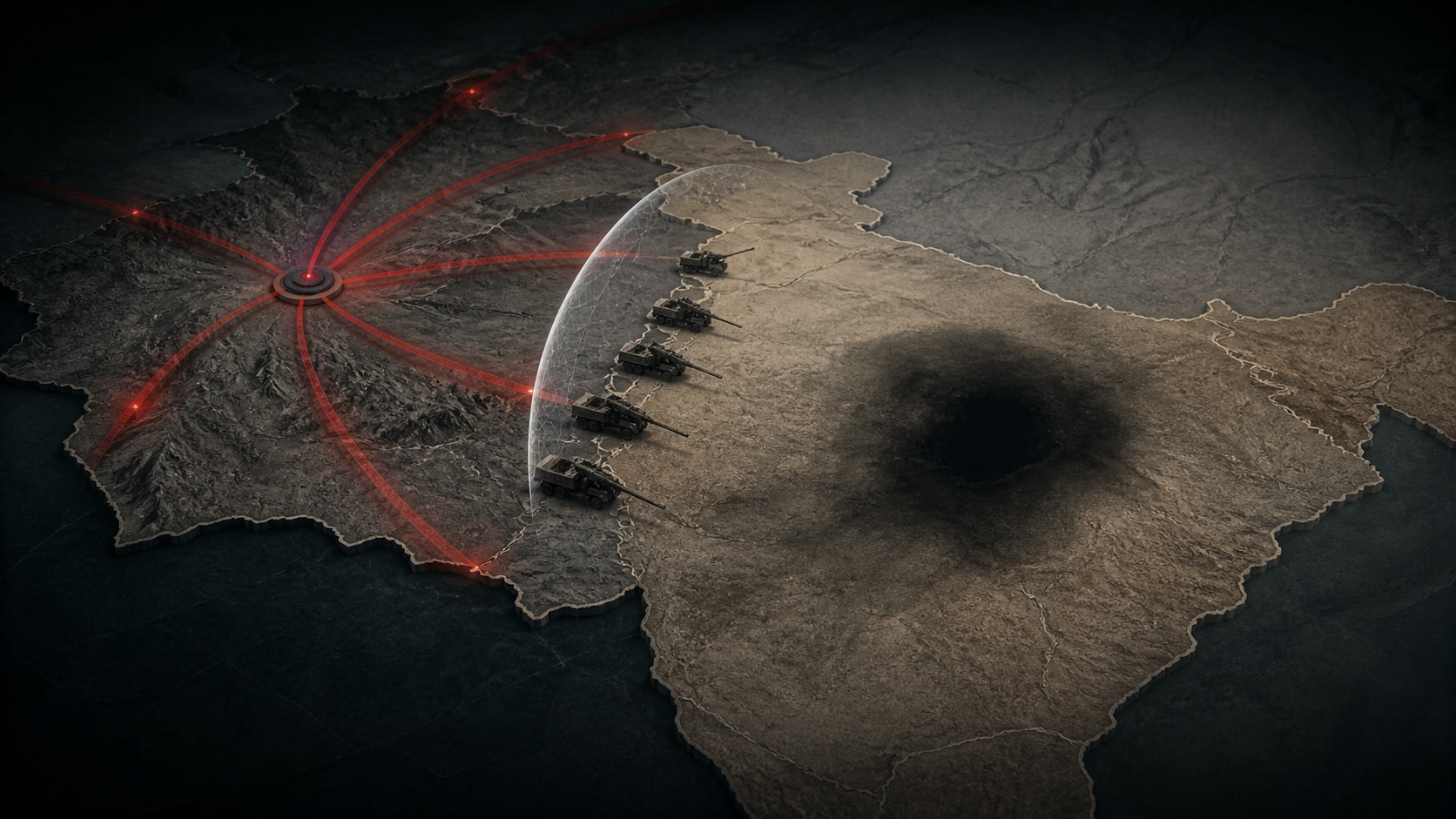
Reports that Pakistan has positioned about 250 Chinese-origin SH-15 155 mm self-propelled howitzers in India-facing formations have attracted the expected attention. The exact number is not independently established; the documented 2019 contract covered 236 systems. What matters is not whether the correct count is 236 or 250. It is the sequence the deployment suggests:
conventional preparation → proxy attack → Indian retaliation → Pakistani conventional response.
The artillery creates an impression: strike our proxy infrastructure and the border becomes a conventional battlefield. Pakistan is also pursuing additional Chinese air-defence systems and Turkish drones after Operation Sindoor. Around Sir Creek and the Gujarat marshes, India is strengthening outposts, surveillance and amphibious capacity amid reports of Pakistani bunkers and forward infrastructure. India's July procurement move for combat boats reflects the vulnerability of terrain long used by smugglers and infiltrators.
The guns are not the real worry. They are the visible part of the reassurance Rawalpindi is building around an invisible act.
China can provide weapons, spares, satellite or other surveillance inputs and rapid replenishment. India's deputy army chief said Beijing supplied Pakistan with live information during Operation Sindoor and identified Turkish military assistance, including drones. That is an Indian military assessment, not a complete independent reconstruction, but it establishes the support India expects in the next conflict. Turkey will supply and train. Direct Turkish combat is doubtful. China's support has limits because Beijing wants Pakistan useful, not destroyed.
Saudi Arabia's calculation is different. Riyadh entered these arrangements because American protection no longer feels sufficient against Iran and its proxies. It wants deterrence-by-association and may want nuclear ambiguity, though no public text proves that Pakistan's arsenal is included. Saudi Arabia has little reason to spend money or weapons on a Pakistani war of choice against India. It would mediate.
The Houthis are already exposing the contradiction through action. Days after the Makkah signing, they said they struck Saudi oil infrastructure; on 12 August a Houthi attack on a ship killed six people, including three Pakistanis. The Associated Press reported the Pakistani deaths as attacks on Saudi interests and shipping continued. Yet Pakistan has little interest in fighting the Houthis or Iran. An anti-Iran war on Saudi instructions risks Shia protest and sectarian disorder at home. Islamabad will mediate, posture as a defender of Muslims, speak loudly about Israel and avoid an offensive campaign.
That tells us what Rawalpindi wants from the pact. Not a war with Iran. Armour against India, however thin; Islamic-protector theatre at home; strategic ambiguity abroad; and enough Saudi, Turkish and possibly American attention to make a short conflict look containable. Israel supplies a useful public enemy for the next stage of the performance. By presenting itself as a shield against Israel, Pakistan can invite other Muslim states into the arrangement while trying to place India, by ideological association rather than fact, on the same enemy list. It is a way to avoid fighting Iran while preserving the costume of Islamic leadership.
Trump's cultivation of Munir and appetite for mediation credit add to the illusion. Pakistan learned that presidential praise and a Nobel Peace Prize nomination could reopen doors in Washington. It assumes the White House will intervene before a short war becomes a catastrophic one. India has drawn the opposite lesson. As BarathVector argued in Trust of Nations, American commitments now look like political weather rather than a foundation. Washington's short-term embrace has bought no durable Pakistani trust and has spent Indian confidence accumulated over two decades. In the next conflict, American intervention may arrive as pressure for a ceasefire. It should not be confused with protection.
Why Sindoor 2 may not stop where Sindoor stopped
Operation Sindoor partially removed the gloves. It demonstrated that India would strike terrorist infrastructure beyond the Line of Control and that Pakistani military retaliation would invite attacks on supporting military assets. Rawalpindi appears to have converted the exchange into a victory narrative and Munir into a field marshal. It may therefore believe the same mechanism can be run again: proxy attack, limited Indian punishment, four or five days of combat, American intervention, domestic victory song.
That is the central miscalculation in this warning.
After another verified Pakistan-sponsored mass-casualty attack, India may not confine itself to camps and their immediate enablers. The target set could expand to the complete machinery that makes proxy war possible: terrorist headquarters, intelligence and military facilities supporting them, air defences and airbases used in retaliation, artillery that enters the fight, and—if escalation continues—economic or maritime capacity that sustains it. Pakistan may initiate the sequence. It will not control the point at which India decides it has imposed enough cost.
Saudi Arabia would try to stop the war. Turkey would send equipment, trainers and intelligence. China would resupply and provide information while avoiding a direct front unless its own interests required one. Washington would seek an early halt and might flatter both sides while doing it. None of them can repeal the fact that Pakistan is conventionally weaker than India and cannot sustain an unlimited contest on equal terms.
The pact may lower the expected cost of war inside the minds of Pakistan's decision-makers. It does not lower the real cost. A war that looks cheaper is easier to start. A war started under a false price is harder to end.
The invisible question
Beyond the likely sequence lies a far less likely but far more dangerous scenario. It must be named carefully because there is no evidence that Pakistan is preparing it.
What happens if a covertly transported nuclear device detonates inside India without a missile track, an aircraft route or an immediately attributable launch point?
India would face a decision for which the old categories are inadequate. Was it nuclear terrorism, a Pakistani nuclear first strike concealed behind a proxy, stolen material, or a third party attempting to trigger a war? Should India answer conventionally, invoke its doctrine of nuclear retaliation, or wait while public pressure and military alert levels rise? Nuclear forensics can analyse post-detonation material and help identify its origin, but authoritative assessments warn that decisive results may take days or longer. Material origin would still not by itself prove who ordered or placed the device.
This is not part of the two-month forecast. It is the tail risk behind the phrase the guns are not the real worry. Pakistan has built its deterrence around ambiguity and the threat of first use against a superior conventional force. Any crisis in which attribution itself becomes the battlefield would compress decision time further and create room for the most consequential error in South Asian history.
India must prepare for that dilemma without pretending preparation proves intent.
The argument against this warning
The strongest objection is simple: every piece can be explained separately.
Balochistan may be another brutal counterinsurgency cycle rather than a final campaign. JAAC remains a reform movement, not an independence army. Artillery deployment may be modernisation and deterrence rather than cover for an attack. Pakistan's government may be telling the truth that Imran Khan is alive. Bangladesh is cooperating with India on border security. Saudi Arabia, Turkey and China all have reasons to prevent a South Asian war. Even an insecure military regime can understand that another Pahalgam would invite a harder Indian response.
All of that is true. Convergence is not proof of conspiracy. The purpose of analysis is not to turn proximity into causation.
The answer is that warnings are built from interacting risks before they become a signed operational plan. Pakistan is suppressing several internal constituencies at once. Its army chief benefits politically from confrontation with India. Proxy infrastructure remains active. Conventional protection is being strengthened. External partners supplied Pakistan during the last exchange. A new pact makes international backing look more plausible than it is. India's declared tolerance for another mass-casualty attack has fallen.
Any one fact is manageable. Their interaction is the danger.
The forecast also has a clear falsifier. Pakistan can dismantle the terror organisations, financial networks, training structures and state relationships that make proxy attacks possible. It can permit independent proof of Imran Khan's life. It can negotiate with Baloch political leaders and JAAC rather than convert them into terrorists by decree. It can move military deployments away from crisis posture and clarify that the Makkah pact cannot be invoked after a Pakistani proxy provocation.
If Rawalpindi does those things, this warning fails—and the failure should be welcomed.
India's posture: prepare without performing
India should not manufacture a crisis in response to a forecast. It should wait, watch and prepare.
Preparation means closing intelligence gaps across the western and eastern approaches, deepening cooperation with Bangladesh without treating Bangladesh as an enemy, hardening cities and critical infrastructure against multi-site attacks, improving nuclear attribution and civil-defence capacity, filling the remaining air-defence and counter-battery gaps, and accelerating domestic production of ammunition, drones, sensors, aircraft, ships and missiles. It also means preparing the evidentiary case before a crisis, so Pakistan cannot use the first hours of confusion to convert a proxy attack into a global story of Indian aggression.
The public has its own role. Remain alert without panic. Refuse rumours designed to create communal violence. Expect Pakistani and foreign information operations to declare victory before facts exist. Do not confuse loud television with preparedness. Psychological steadiness is national capacity.
Friends are welcome. Israel understands the structure of state-supported Islamist violence in a way few nations do. Russia has been more consistent than stronger partners, even as its material capacity has limits. France, Japan and others can supply capabilities and diplomatic weight. None should be asked to protect India in India's place. The United States may remain a market, a technology partner and a useful power. It is not an insurance policy.
The ball is in Rawalpindi's court. India has no need to begin this war, and every reason to prevent it. But if Pakistan again uses proxies to attack Indian civilians, it should not assume that the reaction will remain inside the script it has written, the targets it has prepared or the five-day window its friends prefer.
War clouds are gathering. They are not destiny. Rawalpindi can still choose to dismantle the machinery that produces them.
If it lights the match instead, it will not control where the fire ends.
Friends are welcome. Protection is not outsourced.
BarathVector | Geopolitics | 13 August 2026